The Golden Ratio and Front Yard Design: Achieving Natural Balance with Mathematical Precision
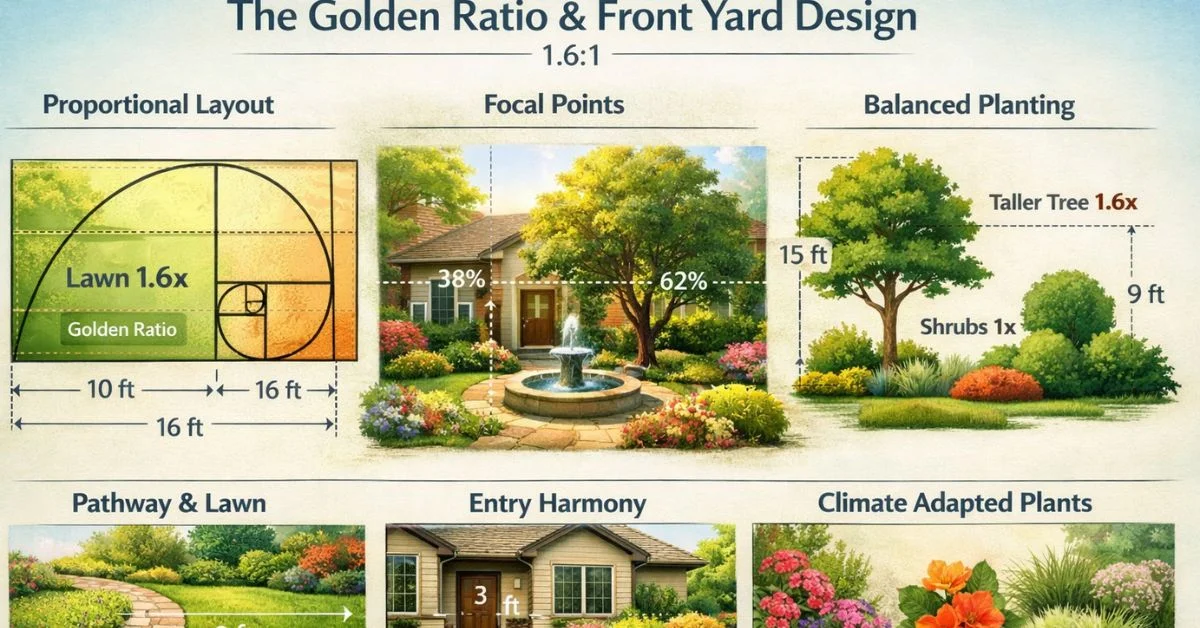
The golden ratio and front yard design converge on the 60% rule. Instead of centering focal points, position specimen trees, key shrubs, or entry walkway curves at a point roughly 61.8% across any measured space. Pair a 5 foot walkway with an 8 foot planting bed, or a 3 foot hedge with a 5 foot border. This 1 to 1.618 relationship mirrors natural growth patterns found in nautilus shells and sunflower spirals. Your eye subconsciously registers this proportion as harmony. The result is a front yard that feels “right” without looking mathematically calculated, enhancing curb appeal through innate visual balance.
The Subconscious Mathematics of Beauty in Landscapes
When you walk past a front yard that feels “off,” your visual cortex is sending a signal that proportions are wrong. You do not need a degree in mathematics to sense this. Your brain is hardwired to recognize the proportional relationships found throughout the natural world: the spiral of a pinecone, the curve of a breaking wave, the branching angle of an oak tree. All of these follow the golden ratio, phi (approximately 1.618).
The golden ratio is not an esoteric formula confined to textbooks. It is the ratio of the whole to the larger part being equal to the ratio of the larger part to the smaller part. In practical terms for front yard design, this translates to a simple toolkit of numbers: 3, 5, 8, 13, and 21. These are the Fibonacci sequence values. As they increase, the relationship between them approaches 1.618. If you have a 5 foot wide section of lawn, it will look most balanced next to an 8 foot long bed. A 13 foot tree canopy reads as proportionate when paired with an 8 foot understory shrub.
The beauty of applying this to your front yard is that you never need to perform complex calculations. The goal is to avoid equal splits. Nature does not divide space into 50/50. A tree placed dead center in the lawn creates a static, artificial look. A tree placed roughly 60% of the way across the space creates dynamic tension and release. This is the foundational principle of the golden ratio and front yard design.
Deconstructing the Phi Formula for the Homeowner
Before laying a single paver or digging a hole, it is essential to understand the two primary ways to apply phi to your property.
The Golden Rectangle
Visualize a rectangle where the length is 1.618 times the width. If your front yard is 40 feet wide, a golden rectangle within that space would measure 40 feet by roughly 65 feet. However, you rarely have a blank canvas. You apply this logic to the subcomponents of the yard. A patio that measures 13 feet by 21 feet fits this ratio. A raised planter box that is 3 feet wide and 5 feet long is inherently more pleasing to the eye than a 4 foot by 4 foot square.
The 60% Rule
This is the most actionable tool in the designer’s kit. Measure any straight line in your front yard. This could be the width of the house facade, the distance from the sidewalk to the front porch, or the length of a planting bed. Find the point that is 61.8% of that distance. That is where the eye naturally wants to rest. Place a focal point exactly there. Do not center it. If your walkway is 20 feet long, the golden ratio point is at 12.4 feet. That is where a specimen Japanese maple, a distinctive boulder, or a cluster of tall grasses should reside. This single adjustment elevates a layout from amateur to intentional.
Practical Applications: The Hardscape Skeleton
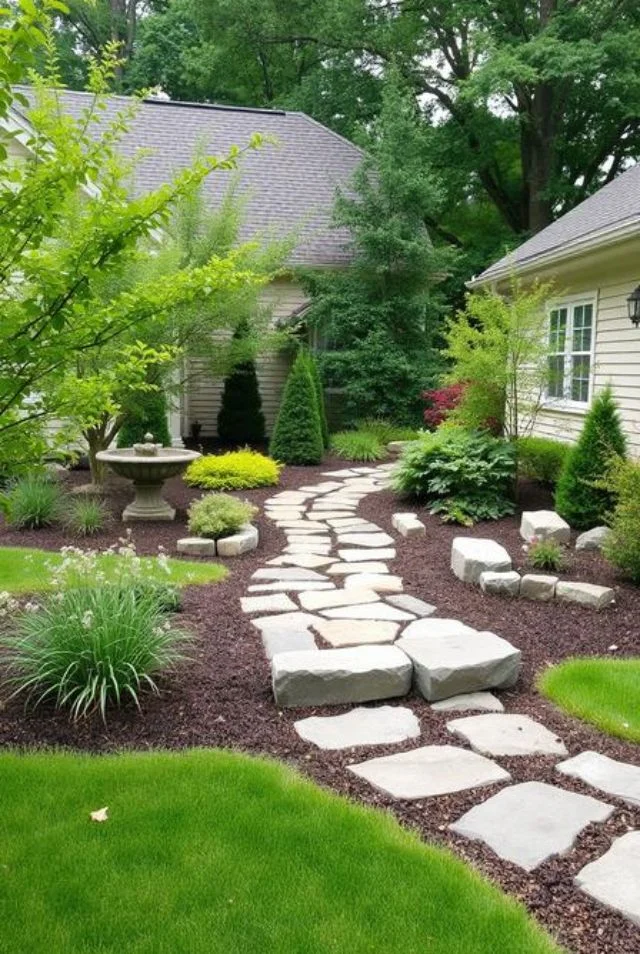
Hardscape forms the bones of the front yard. If the bones are poorly proportioned, even the most expensive plantings will look like an afterthought.
Walkways and the 5 to 8 Relationship
The most common mistake in front yard design is the “shoestring” planting bed. This is the narrow 2 foot strip of mulch squeezed between a 4 foot concrete walk and the house foundation. It looks pinched because it violates the golden ratio. A 4 foot walkway pairs best with a planting bed of 6.5 to 7 feet in depth. A 5 foot walkway achieves harmony with an 8 foot deep bed. If you are constrained by space, you can flip the ratio: use a narrower walkway (3 feet) to allow for a more generous 5 foot bed. This proportion allows plants to achieve their mature width without spilling over the pavement, creating a soft, billowing edge instead of a rigid barrier.
Driveway Transitions and Approach Sequences
The journey from the curb to the front door is a narrative. The golden ratio can script this narrative through curves and landings. A straight concrete driveway running parallel to the property line creates a narrow tunnel of wasted space. Instead, consider a sweep. If the driveway must be straight, use the 60% rule for the transition point where the hardscape meets the front walk. For example, if the front of the house is 30 feet wide, do not place the front steps in the middle (15 feet). Place the entrance or a prominent landing feature at the 18.5 foot mark. This slight asymmetry draws the visitor’s eye toward the entry in a more welcoming, less confrontational manner.
Retaining Walls and Vertical Elevations
The golden ratio applies as much to height as it does to width. A retaining wall that is 3 feet high will look most substantial and grounded when constructed in sections of approximately 5 feet. A 5 foot high wall works well in 8 foot segments. This prevents the wall from looking either squat (too long for its height) or looming (too high for its length). Furthermore, the relationship between the wall and the plant material above it matters. If you have an 8 foot tall hedge behind a 5 foot wall, the ratio (8:5) provides a visual step that feels natural, mimicking the layered edge of a forest.
The Living Layer: Applying Phi to Planting Design
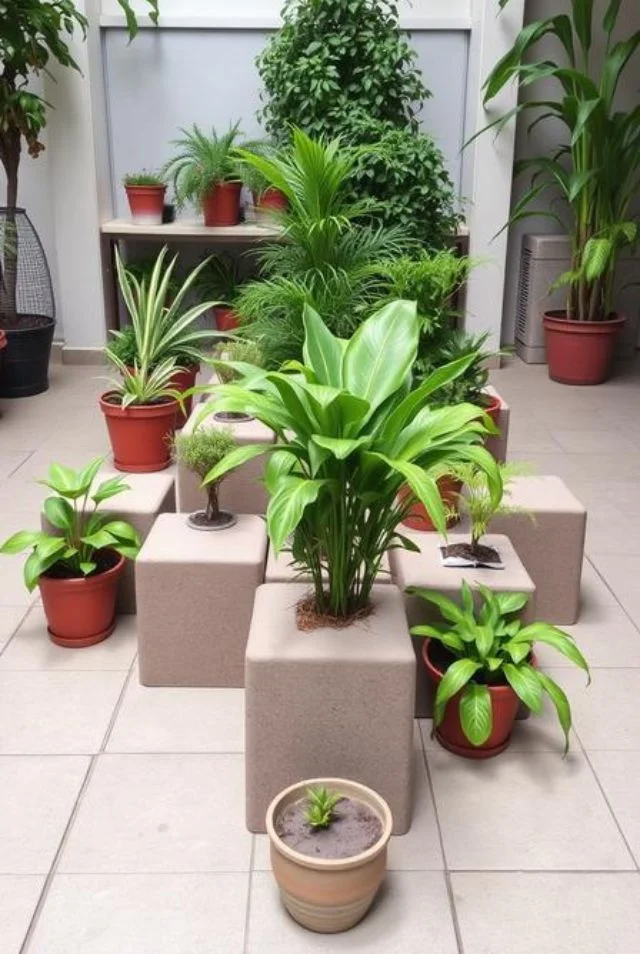
Plants are not static blocks of concrete. They grow, sway, and change. However, their placement and grouping can be governed by the same mathematical truths that govern their growth patterns.
The 3 5 8 Vertical Layering Framework
Professional landscape architects avoid the rigid “tall, medium, short” stair step because it looks artificial. Instead, they use a layered approach based on Fibonacci numbers. This is often referred to as the 3 5 8 rule:
- The 3 Foot Layer: Groundcover and low mounding perennials. This includes sedum, creeping phlox, dwarf mondo grass, and ajuga. These plants knit the soil together and soften the edges of hardscape.
- The 5 Foot Layer: This is the workhorse of the garden. Ornamental grasses, hydrangeas, spirea, lavender, and shrub roses occupy this zone. They provide mass, texture, and the primary color impact.
- The 8 Foot Layer: This is the structural understory. Small trees like serviceberry, redbud, flowering dogwood, and upright evergreens like ‘Sky Pencil’ holly or arborvitae create the vertical punctuation.
The relationship between these layers (3:5 and 5:8) approximates phi. When you look across a border and see a drift of 3 foot tall Russian sage against a backdrop of 8 foot tall ‘Green Giant’ arborvitae, the proportion reads as expansive and calm.
Grouping in Odd Numbers and Fibonacci Drifts
The human eye finds even numbered groupings (2, 4, 6) to be static and formal, suitable for a colonial revival but often out of place in a contemporary or cottage front yard. Odd numbers create movement. Three coneflowers read as a group. Five read as a drift. Eight read as a colony.
For maximum impact, apply Fibonacci numbers to the quantity of plants in a drift:
- Group of 3: Good for a small accent by the mailbox or a focal point at the 60% mark.
- Group of 5: Ideal for a mid border sweep.
- Group of 8 or 13: Use this for the dominant groundcover or the main structural hedge. Instead of planting 10 boxwoods in a row, plant 8 or 13. The difference in visual density is subtle but profound.
Color Distribution and Visual Weight
The golden ratio also governs the distribution of color weight in a composition. The 60 30 10 rule of interior design is a direct descendant of phi. Apply this to your front yard palette:
- 60% Dominant Hue: This is usually the green foliage or a specific leaf texture. In a flowering garden, this could be the primary color of the season (e.g., purple salvias).
- 30% Secondary Hue: The complementary or supporting color. For purple salvias, this might be the chartreuse of ‘Angelina’ sedum or the silver foliage of lamb’s ear.
- 10% Accent Hue: The spark. This is the small pop of contrasting color, like a single orange geum or a white blooming hydrangea that catches the light at dusk. This prevents the garden from becoming a chaotic rainbow while ensuring it is never boring.
Case Study: The Phi Spiral in a Real Front Yard Transformation
The Washington State project mentioned at the outset provides a masterclass in applying these principles beyond rectangles and into organic curves. The landscape designer, Lisa Port, faced a site with a steep grade change and a desire for a modern, sculptural look. The homeowners specifically requested the golden ratio.
The Solution: The Curved Steel Wall
Rather than terracing the hill with straight block walls, Port designed a steel wall that spirals in both plan view (looking down) and elevation view (looking from the front). The radius of the spiral increases as it descends the slope. The relationship between the changing radii follows the Fibonacci sequence. As the wall sweeps across the front yard, it creates a series of “rooms” or pockets. The width of these pockets relative to their length adheres to the 1:1.618 proportion.
The Poolette Proportions
The centerpiece of the lower terrace is an inground hot tub (dubbed the “poolette”). Its dimensions are not arbitrary. The length of the tub is 1.618 times the width. Because the tub is placed within the curve of the steel spiral, the water reflects the sky and the surrounding grasses in a way that feels meditative. The eye is drawn along the spiral wall, which acts as a leading line, depositing the viewer’s gaze precisely at the 61.8% point of the overall view.
Planting in the Spiral Beds
The beds created by the wall are filled with a mix of native grasses and perennials. The design uses a 60% dominance of fine textured switchgrass (Panicum virgatum), 30% mid texture coneflowers (Echinacea purpurea), and 10% bold accent of ‘Blue Star’ juniper. The height ratios between the grass (5 ft) and the coneflowers (3 ft) and the juniper (2 ft) create a textural golden ratio.
This project proves that the golden ratio and front yard design is not about creating a rigid, formal garden. It is about finding the mathematical anchor that allows curves, slopes, and wild plantings to feel grounded and intentional rather than messy.
Golden Ratio Meets 2026 Sustainability Trends
The design priorities for 2026 are shifting away from sterile, water hungry turf lawns toward climate adaptive ecosystems. The golden ratio is the perfect tool to ensure these new sustainable landscapes look designed rather than neglected.
The Micro Meadow Proportion
A major 2026 trend is replacing the front lawn with a native “micro meadow.” The risk is that a meadow of wildflowers and grasses can look like a forgotten lot rather than a garden. The solution is proportion. Use the golden ratio to define the edge. If the total front yard is 1,000 square feet, the meadow area should occupy either 618 square feet (with 382 square feet of structured hardscape or mowed buffer) or vice versa. The contrast between the “wild” (the meadow) and the “controlled” (a crisp steel edge or a gravel strip) is what signals intent.
Edible Front Yards and Phi Raised Beds
Vegetable gardening is moving from the backyard to the front curb appeal zone. To make this look elegant, apply golden rectangles to raised bed construction. A bed measuring 5 feet wide by 8 feet long is the perfect size for reaching the center from either side while maintaining a visually pleasing footprint. Group three of these beds together, offset them slightly using the 60% rule, and surround them with gravel. The result is a potager that enhances home value rather than detracting from it.
Four Season Structure
With 2026’s emphasis on year round interest, plants with winter architecture are non negotiable. Place these structural anchors (evergreen shrubs, sculptural deciduous trees like Harry Lauder’s walking stick) at the golden ratio points. When the perennials die back in November, the “bones” of the garden remain. Because those bones are spaced using phi, the winter garden still reads as a composition. A yard with a specimen weeping blue atlas cedar placed 61.8% of the way across the facade will hold visual weight against the snow, whereas a cedar placed in the middle will look lonely and out of place.
Common Pitfalls and How to Correct Them
Even with the best intentions, homeowners often misinterpret the golden ratio and front yard design. Here are the most frequent errors and their simple remedies.
Pitfall 1: The Centered Specimen Tree
This is the classic mistake. The tree is planted exactly halfway between the house corner and the property line.
The Fix: If the tree is already established, you cannot move it. You can, however, change the visual anchor. Add a secondary element (a large boulder or a taller shrub grouping) at the 60% mark on the other side of the yard. This shifts the visual weight and restores dynamic balance.
Pitfall 2: The “Stripe” Lawn
This occurs when the lawn is a wide rectangle, the bed is a narrow strip against the house, and the walkway is another narrow strip. The proportions are often 10:2:3.
The Fix: Expand the bed depth to 5 or 8 feet. Reduce the lawn width to 13 feet. This creates the 5:8:13 sequence across the front of the house, unifying the space.
Pitfall 3: Inconsistent Vertical Scaling
A 20 foot tall mature oak next to a 2 foot tall boxwood hedge creates a jarring 10:1 ratio.
The Fix: Insert an intermediate layer. Add a row of 8 foot tall viburnum or a mid sized ornamental tree (13 feet) between the giant and the dwarf. This creates the stepped proportion of 2:8:13 (or approximately 1:4:6.5), which is visually digestible.
Pitfall 4: Obsessive Measuring
While phi is mathematical, the garden is organic. Aim for approximations. If you measure 61.8 inches and place the plant at 62 inches, you have succeeded. The eye cannot distinguish a 1% error. The principle is more important than the precision.
Implementing the Design: A Step by Step Guide
Use this practical workflow to apply the golden ratio to your front yard without hiring a mathematician.
Step 1: The Site Assessment
Measure the total width of your lot at the street and at the house. Measure the depth from the curb or sidewalk to the front door. Sketch these lines on paper.
Step 2: Identify the Fixed Focal Point
In almost all front yards, the front door is the ultimate focal point. It is the destination. Use the 60% rule to determine where the secondary focal point belongs in relation to the door. If the front facade is 40 feet wide and the door is at 25 feet (off center), the golden ratio point for a specimen tree or sculpture might be at 15 feet on the other side to balance the composition.
Step 3: Hardscape Sizing
Decide on your walkway material and width. If you choose a 5 foot wide bluestone path, immediately plan for planting beds that are at least 8 feet deep adjacent to it. If space is tight, adjust the walkway down to 3 feet wide to allow for a 5 foot deep bed.
Step 4: The Fibonacci Plant List
When you go to the nursery, have a list based on numbers, not just names.
- Canopy (13+ ft): 1 specimen tree.
- Understory (8 ft): 3 flowering dogwoods or 5 upright junipers.
- Shrubs (5 ft): 8 hydrangeas or 13 dwarf boxwoods.
- Perennials (3 ft): Masses of 21 or 34 (planted in drifts of 5 or 8).
Step 5: The Staking Exercise
Before digging, use landscape paint or a garden hose to mark the proposed bed lines on the grass. Walk to the street. Walk to the neighbor’s driveway. Look from the upstairs window. Check the 60% focal point. Is it roughly where you planned? Adjust the hose now, before you commit with a shovel.
Step 6: Layering Installation
Install the largest elements first (trees, then shrubs, then perennials). As you place each layer, step back and check the height relationship. The 3 foot plant should visually nestle into the 5 foot plant. The 8 foot plant should hover just above the 5 foot plant.
Tools and Resources for Golden Ratio Design
While a calculator is optional, these resources can help you visualize the geometry.
- Fibonacci Gauge (Golden Mean Calipers): A physical tool with three points that automatically opens to the golden ratio. You can use this to quickly check the proportion between a tree canopy and its trunk, or a pot and its pedestal.
- Smartphone Camera Grid Overlay: Many camera apps allow a “Phi Grid” overlay instead of the standard Rule of Thirds grid. Use this to frame photos of your yard. Where the grid lines intersect are the natural points of interest. Place your key plants there.
- Online Golden Rectangle Calculator: Input the width of your planting bed, and the calculator will give you the ideal length.
- Graph Paper and a 1.618:1 Ratio: Use this to scale your yard. For every 1 square of graph paper width, use 1.6 squares for the length.
Conclusion:
The golden ratio and front yard design is less about calculation and more about observation. It is the language of nature translated into landscaping. By shifting your perspective from symmetry to proportion, from centering to the 60% rule, you align your front yard with the visual logic that our brains have been decoding since birth. The result is not a yard that looks like a geometry proof. It is a yard that looks like it belongs exactly where it is, a seamless transition from the built environment of the house to the organic world of the garden. The next time you walk out to the curb, look at the line of your house against the sky. Somewhere around 61.8% of the way across, the perfect spot is waiting for a tree, a stone, or a drift of flowers. Plant it there. Your eye will thank you.
FAQs
1. What is the 60% rule in front yard landscaping?
The 60% rule means placing focal points like trees or sculptures at roughly 61.8% across a measured space rather than the center, creating a natural, dynamic visual balance.
2. How do I use the golden ratio for planting bed sizes?
Pair a 5 foot wide bed with an 8 foot long bed or a 3 foot shrub with a 5 foot border to achieve the pleasing 1:1.618 proportion.
3. Does the golden ratio apply to small front yards?
Yes, small yards benefit even more; use a 3 foot walkway with a 5 foot planting strip or apply the 60% rule to a single specimen container for immediate harmony.
4. What plants naturally follow the golden ratio or Fibonacci sequence?
Plants with spiral patterns like sunflowers, pinecones, and succulents, or blooms with 3, 5, 8, or 13 petals visually reinforce the mathematical proportions of the garden.
5. How do I find the golden ratio point in my front yard without math?
Divide your yard’s width by 1.6, or simply place your key element at roughly two fifths of the distance from one edge for an instant phi approximation.

As an admin, with a passion for transforming spaces and a sharp eye for design trends, I created Interior Design Style Quiz to help homeowners make confident, informed decisions about their homes from the curb all the way inside.