23 Heuchera Garden Ideas for Stunning Colorful Landscapes
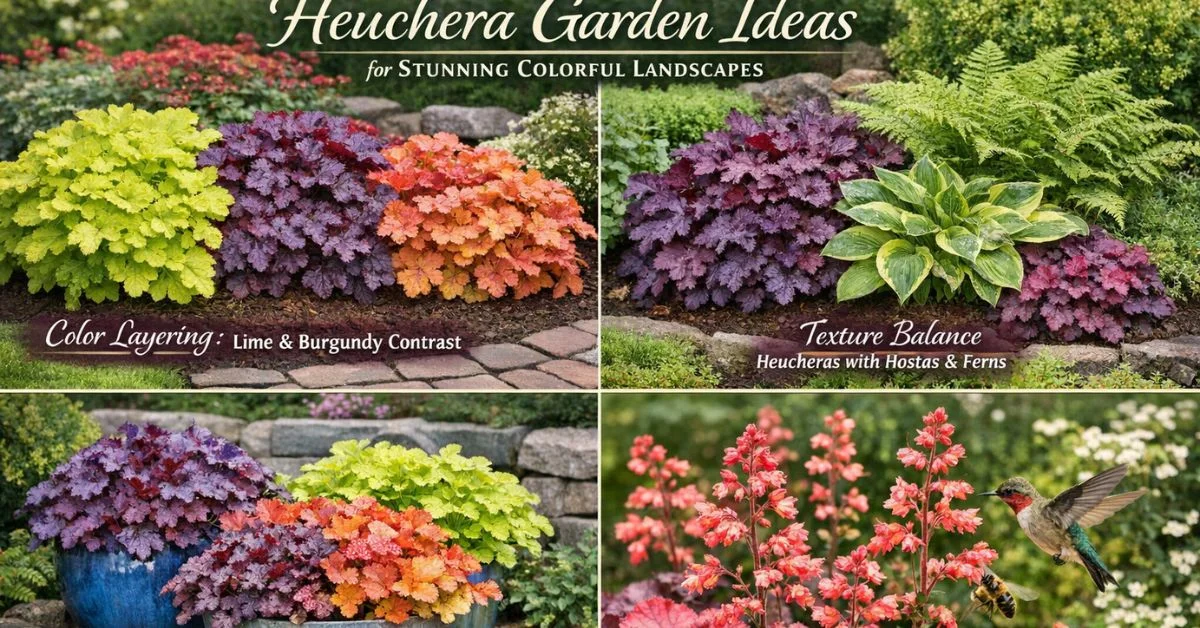
Heuchera garden ideas succeed when you treat coral bells as permanent foliage architecture rather than temporary floral filler. Mass a single cultivar like ‘Palace Purple’ or ‘Caramel’ in groups of five or seven for cohesive visual weight, position dark leaved varieties as anchors that make chartreuse companions glow, and leverage the genus’s evergreen presence to maintain structure through winter dormancy. The most effective designs pair Heuchera with ferns for textural contrast, underplant deciduous shrubs for layered interest, and deploy trailing Heucherella hybrids on slopes for erosion control. For expert results, select cultivars based on site specific light conditions rather than catalog color alone, and divide clumps every three years to prevent woody center decline.
Design Foundations: Color Theory and Massing Strategy
Mass Planting for Visual Impact
One of the most persistent errors in Heuchera garden use involves scattering individual specimens throughout a border like botanical confetti. University extension horticulturists consistently emphasize that coral bells achieve their greatest aesthetic power when identical or closely related cultivars appear in groups of three, five, or seven specimens planted approximately eighteen inches center to center. This repetition creates a visual block that the eye reads as intentional design rather than random collection.
A mass of ‘Palace Purple’—the 1991 Perennial Plant of the Year that remains among the most reliable performers across varied climates—provides a grounding anchor in mixed borders that might otherwise feel disjointed. Similarly, drifts of amber toned selections like ‘Caramel’ or ‘Southern Comfort’ warm cool woodland settings with remarkable consistency. When designing for commercial or institutional landscapes where maintenance schedules may prove irregular, massing a single proven cultivar reduces visual noise while ensuring the planting remains legible even as individual specimens mature at slightly different rates.
Orchestrating Color Gradients
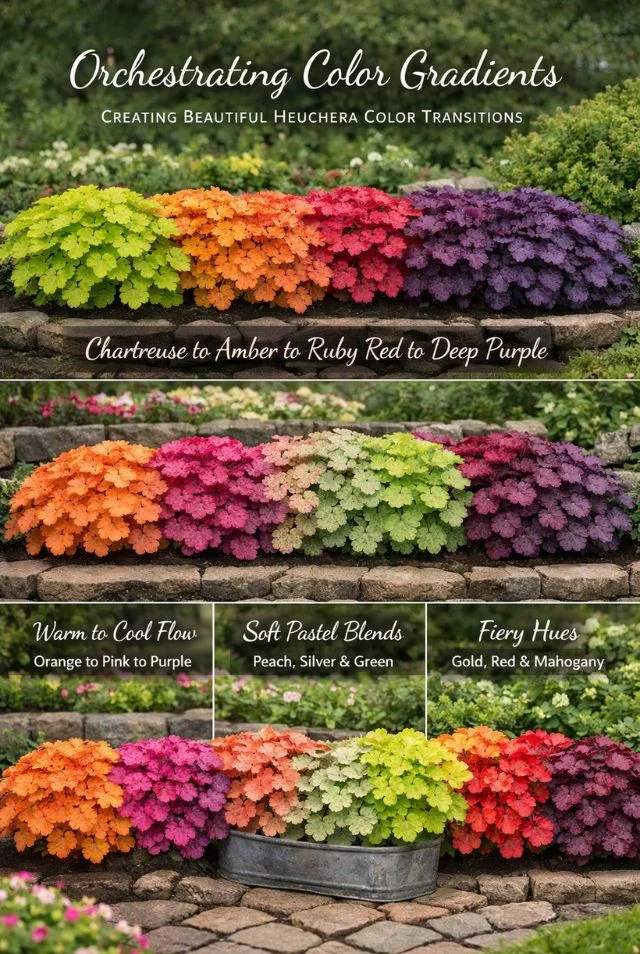
Creating intentional color transitions elevates Heuchera garden compositions from pleasant to memorable. Position cultivars along a spectrum moving from deepest burgundy selections such as ‘Obsidian’ and ‘Black Pearl’ through rich purple intermediates like ‘Plum Pudding’ and ‘Wildberry,’ transitioning into amber warm tones with ‘Caramel’ and ‘Marmalade,’ and finally arriving at lime green accents like ‘Lime Marmalade’ and ‘Pistache.’
Position these graded plantings along pathways or border fronts where the eye can travel through the color progression. For compact gardens, limit the palette to two or three carefully selected varieties to maintain cohesion. Larger spaces accommodate broader sweeps with multiple transitional steps. The critical principle involves maintaining visual momentum: abrupt color jumps disrupt the intended flow, while graduated shifts create a mesmerizing progression that rewards extended viewing.
Dark Foliage as Design Anchor
Near black Heuchera garden cultivars represent some of the most underutilized tools in the designer’s arsenal. ‘Obsidian,’ ‘Black Pearl,’ and the dramatic ‘Dressed Up Evening Gown’—with its deeply ruffled velvety black leaves and almost metallic sheen—provide exceptional anchoring weight in compositions that might otherwise feel insubstantial or scattered.
These dark selections serve multiple design functions simultaneously. They create visual rest stops that allow the eye to pause before moving to brighter neighboring elements. They absorb light in a manner that makes adjacent chartreuse or silver foliage appear more luminous by direct contrast.
Chartreuse as Shade Illuminator
In the deepest shade conditions where flowering plants consistently struggle, chartreuse Heuchera garden varieties function as living light sources. Cultivars like ‘Pistache,’ ‘Lime Rickey,’ and Primo ‘Pistachio Ambrosia’ reflect available light with remarkable efficiency, creating the illusion of dappled sunshine even in locations where direct rays rarely penetrate the canopy.
The gently scalloped edges and fine veining of these bright varieties add refinement while the luminous foliage transforms shaded areas from perceived problem zones into deliberate design features. Pair chartreuse Heuchera with deep green ferns or darker leaved Heuchera varieties to amplify the contrast effect. Note that many lighter colored forms tolerate morning sun exposure, which often enhances their vibrancy, but require protection from harsh afternoon light to prevent foliar scorch and bleaching.
Silver and Pewter Sophistication
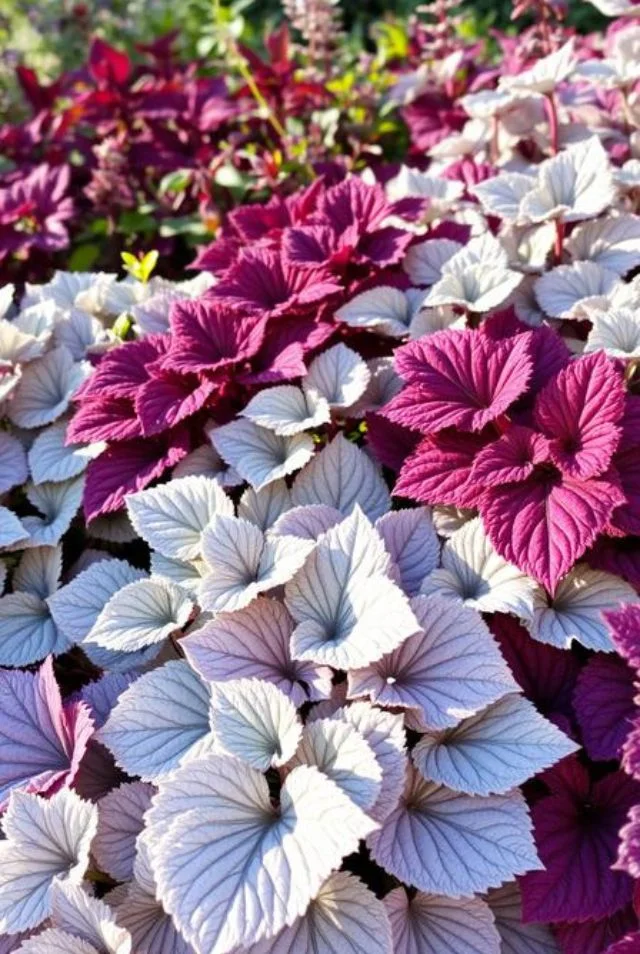
Silver leafed Heuchera garden including ‘Silver Scrolls,’ ‘Burgundy Frost,’ and ‘Silver Gumdrop’ offer a cooler toned alternative to the genus’s more saturated offerings. Heuchera ‘Silver Gumdrop’ displays lobed leaves in silver gray with purple undertones and deeper purple undersides, creating layered interest that reveals itself gradually as light shifts throughout the day and across seasons.
These cool toned varieties excel in contemporary garden designs where restraint and refinement take precedence over exuberant color displays. Pair them with blue leaved hostas, Brunnera ‘Jack Frost’ for silver on silver textural interplay, or Pulmonaria selections for coordinated early spring bloom.
Seasonal Color Choreography
Many Heuchera garden varieties undergo significant foliage color transformation from spring emergence through fall senescence—a design asset that remains chronically underutilized even among experienced practitioners. Early in the growing season, these plants frequently display brighter more saturated colors that gradually deepen and shift over summer months. ‘Pinot Gris’ exemplifies this quality, with leaf tones that evolve continuously throughout the year, ensuring the visual spectacle is never quite the same twice.
Spatial Design and Site Specific Applications
Woodland Understory Integration
Heuchera garden North American provenance makes it an ideal candidate for native and naturalistic woodland garden applications. Species like Heuchera villosa—commonly known as hairy alumroot and native to eastern United States woodlands from New York to northern Georgia—thrives in partial shade or dappled sunlight with consistently moist, well drained soil high in organic matter content. Reaching up to thirty two inches in height, it represents one of the largest alumroots available, with heat and humidity tolerance that many hybrid cultivars noticeably lack.
Mass Heuchera villosa on wooded slopes, in small groups bordering woodland walkways, or as a transitional layer between managed lawn areas and natural forest edge. The species’ documented tolerance for rocky, wooded slopes and exposed ledges makes it particularly valuable for sites where extensive soil preparation proves impractical or undesirable.
Formal Garden Applications
Contrary to persistent assumptions that Heuchera belongs exclusively to informal cottage or woodland garden settings, certain species and cultivars lend themselves remarkably well to formal and modern design aesthetics. Heuchera richardsonii, with its substantial maple like basal foliage and tall, erect, vertical bloom stalks, can be effectively massed in formal squares, triangular groupings, or precise linear rows.
This native species, distributed across the northern United States and much of Canada, provides the orderly shapeliness that formal designs demand while maintaining legitimate ecological value as a native plant selection. The blooms and stalks show to better advantage in thicker plantings, while the foliage offers pleasing contrast to the thinner linear leaves of sedge and grass species that might form the matrix of a modern minimalist composition.
Erosion Control Applications
Heuchera garden clumping growth habit and fibrous root systems offer significant erosion control benefits on slopes where conventional turfgrass establishment proves challenging or maintenance intensive. Groups of Heuchera cover bare soil around taller perennials and shrubs, stabilize soil on inclines, and create areas where mulch application becomes unnecessary once the foliage canopy closes completely.
This functional application transforms what might otherwise be considered a maintenance burden into a legitimate design opportunity. On sloped residential or commercial sites, interplant Heuchera maxima—a large leafed native species from California’s Channel Islands—with complementary erosion controlling perennials and low growing shrubs. The dense foliage mat stabilizes soil while delivering year round visual interest that bark mulch alone cannot provide.
Pathway Edge Definition
Heuchera excels as a pathway edging plant where its mounding habit creates a soft, continuous border that defines circulation routes without the harshness of hardscape materials. Extension horticulturists consistently recommend Heuchera for edging applications, noting its capacity to provide a distinctive appearance that enhances shaded or partially shaded garden paths and walkways.
For maximum effectiveness, select a single cultivar to maintain consistent height and color along the entire path length. Space plants approximately twelve to eighteen inches apart, allowing for full spread while preserving the continuous line that makes edging effective.
Container Design Strategies
Expert container design with Heuchera requires understanding that different cultivars serve distinct roles within the classic thriller filler spiller compositional framework. While most Heuchera function primarily as fillers—low, mounded forms occupying the middle ground of container plantings—strategic cultivar selection expands their utility considerably.
Taller cultivars like Heuchera ‘Dressed Up Evening Gown’ with its dramatic flower spikes can serve effectively as thrillers in smaller container compositions. Trailing Heucherella hybrids from the Falls and Cascade series, such as ‘Copper Cascade’ with its rosy copper gold foliage and clean draping habit, provide excellent spill functionality for window boxes and balcony planter arrangements.
Companion Planting Relationships
The Hosta Partnership
Heuchera and hosta combinations form a foundational partnership for deep shade garden design. The Heuchera provides dense, ruffly mounded forms, while the Hosta contributes broad, smooth, and sometimes heavily ribbed architectural leaves. This substantial contrast in leaf size and surface texture prevents shade beds from reading as uniform or visually heavy.
Successful deployment of this pairing requires careful attention to scale relationships. Large hosta varieties like ‘Sum and Substance’ or ‘Blue Angel’ create dramatic textural contrast when underplanted with finer textured Heuchera selections such as ‘Wildberry’ or ‘Plum Pudding.’ Conversely, miniature hosta varieties like ‘Blue Mouse Ears’ pair effectively with compact Heuchera selections in smaller spaces or container compositions.
Fern Textural Dialogue
The delicate, feathery fronds of ferns provide an ideal counterpoint to Heuchera’s broader, scalloped leaf forms. This textural conversation achieves particular effectiveness in woodland garden settings where dappled light conditions suit both genera equally well. Edge a shaded path with a flowing combination of Heuchera and fern varieties for a composition that feels simultaneously natural and carefully curated.
Japanese painted fern (Athyrium niponicum var. pictum) offers particular synergistic potential, its silver and burgundy fronds echoing the metallic and purple tones found in many Heuchera cultivars. Autumn fern (Dryopteris erythrosora) provides coppery spring fronds that harmonize with amber toned Heuchera varieties like ‘Caramel’ or ‘Marmalade.’ For larger scale applications, ostrich fern (Matteuccia struthiopteris) creates dramatic vertical contrast with lower growing Heuchera selections, establishing clear visual hierarchy within the planting composition.
Astilbe Vertical Accent
Astilbe produces fluffy, feathery plumes that rise above Heuchera’s low mounds, creating essential vertical contrast while occupying the same cultural niche. Both plants thrive in moist, organic soil with consistent moisture availability, and their bloom times frequently overlap, creating a coordinated display that maximizes visual impact during the peak growing season.
The partnership extends beyond spatial dynamics into temporal succession planning. While Heuchera provides continuous foliage presence throughout the growing season, Astilbe’s bloom period—typically mid to late summer depending on variety—offers a punctuation mark that refreshes the composition when early summer perennials have concluded their display.
Spring Ephemeral Layering
The shade garden’s primary design challenge involves maintaining visual interest through the full growing season. Heuchera’s evergreen to semi evergreen habit provides a stable foundation that can be strategically layered with spring ephemerals—plants that emerge early, complete their bloom cycle, and then retreat as summer progresses.
Bleeding heart (Dicentra spectabilis) offers a classic combination partner, its arching stems and distinctive heart shaped flowers providing early structure before its foliage dies back in summer heat, allowing Heuchera to assume center stage without competition. Similarly, lungwort (Pulmonaria) blooms as Heuchera emerges in spring, with silver spotted leaves continuing to provide foliar contrast long after flowers fade.
Ornamental Grass Movement
Ornamental grasses introduce kinetic energy to Heuchera compositions, their flowing, upright forms playing against the static, mounded habit of coral bells. This partnership achieves particular effectiveness in part sun conditions where both plant types thrive with moderate moisture and good drainage characteristics.
Blue fescue (Festuca glauca) provides fine textured blue toned foliage that creates striking contrast with burgundy or amber Heuchera selections. Japanese forest grass (Hakonechloa macra), especially golden forms like ‘Aureola,’ offers a cascading habit that softens border edges while its chartreuse tones harmonize beautifully with lime green Heuchera varieties. For larger scale applications, switch grass (Panicum virgatum) or little bluestem (Schizachyrium scoparium) introduce vertical structure and fall color that extends the composition’s seasonal reach well into autumn.
Shrub Underplanting Strategy
Heuchera excels as an understory layer beneath larger shrubs, where it fills the visual gap between ground plane and canopy while benefiting from the dappled shade conditions that larger plants naturally create. This application proves particularly valuable beneath rhododendrons and azaleas, where Heuchera’s colorful leaves enrich spring floral displays and maintain visual interest once those flowers inevitably fade.
Advanced Cultivar Selection
Trial Validated Performance
The 2025 trial season produced clear winners that deserve priority consideration in professional design specifications. Terra Nova Nurseries’ Heuchera ‘Changeling’ achieved perfect five point zero ratings at the Penn State Flower Trials, earning both “Best of Show” and “Best of Species” awards in sun category evaluations, plus a four point nine five rating and “Director’s Select” designation in shade assessments.
Additional top performers included Heuchera ‘Iridescent’ and Heuchera ‘Rosewood,’ both scoring perfect five point zero ratings at the Raker Roberta Trial Gardens for season long vigor, consistent color retention, and overall hardiness. Heuchera ‘Peach Smoothie’ recorded notably high scores at the University of Tennessee Gardens evaluations.
Cold Climate Performance
For Heuchera garden situated in USDA Zones 3 and 4, where winter hardiness eliminates many otherwise attractive Heuchera options, the Northern Exposure series—bred from Heuchera richardsonii, a species native to the northern United States and much of Canada—provides exceptional cold tolerance down to Zone 3 conditions.
This series includes ‘Northern Exposure Amber’ with warm amber foliage tones, ‘Northern Exposure Black’ featuring dark purple black leaves, ‘Northern Exposure Lime’ with bright lime green foliage and rust red flower spikes, ‘Northern Exposure Purple’ displaying rich purple coloration, ‘Northern Exposure Red’ with long season red leaf tones, ‘Northern Exposure Sienna’ offering chartreuse leaves with distinctive orange venation, and ‘Northern Exposure Silver’ with purplish silver foliage.
Heat and Humidity Tolerance
In the southeastern United States and other regions where summer heat and humidity challenge many Heuchera cultivars, species based selections offer demonstrably superior performance. Heuchera villosa, known commonly as hairy alumroot, demonstrates exceptional heat and humidity tolerance, maintaining vigor through extended conditions that cause significant decline in less adapted hybrid selections.
Cultivars derived from Heuchera villosa bloodlines, including ‘Autumn Bride’ with fuzzy green leaves and clean white flowers, ‘Chantilly’ featuring green leaves tinted with bronze undertones, and ‘Purpurea’ displaying coppery purple foliage, inherit this environmental resilience while offering refined ornamental characteristics.
Trailing Forms for Groundcover
The introduction of trailing Heucherella and Tiarella series represents a significant expansion of design possibilities for the genus. Terra Nova’s response to increased professional demand for trailing foliage has produced three distinct collections suited for controlled spread, container spill applications, and cohesive ground coverage in both sun and shade conditions, including notably dry shade beneath established deciduous trees.
Mediterranean and Coastal Adaptations
For gardens situated in Mediterranean climate zones or coastal environments where water conservation represents a primary design consideration, species Heuchera native to California’s Channel Islands offer superior drought tolerance once established. Heuchera maxima, known commonly as island alum root, evolved in shady areas beneath tree canopies and in sheltered canyon environments, thriving in dappled sun conditions with remarkably little supplemental maintenance required following establishment.
This California native reaches approximately twelve inches in height with wide, distinctly marbled leaves and pink flowers that emerge on stalks held above the foliage in spring. Along the immediate coast, it can thrive in full sun exposure without significant decline. The species tolerates sandy, loamy, or rocky soil conditions with neutral pH and demonstrates rapid growth once root systems establish. For designers specifying plants in water wise gardens, Heuchera maxima and its hybrids provide the coral bells aesthetic without the irrigation demands characteristic of many commercially available hybrid cultivars.
Practical Cultivation and Maintenance
Site Preparation and Planting
Proper site preparation significantly influences long term Heuchera performance regardless of cultivar selection. These plants require well drained soil conditions; consistently saturated root zones lead predictably to crown rot and plant decline. In heavy clay soils, incorporate generous amounts of organic compost and horticultural grit or coarse sand to improve drainage characteristics before planting.
Watering Requirements
While established Heuchera plants demonstrate reasonable drought tolerance, particularly species selections and dark leaved cultivars, consistent moisture through the first growing season remains essential for proper establishment. Provide approximately one inch of water weekly during this critical period, adjusting based on rainfall and site specific conditions.
Fertilization Approach
Heuchera responds favorably to modest fertility inputs rather than heavy feeding regimes. Apply a balanced, slow release organic fertilizer in early spring as new growth emerges. Alternatively, a light topdressing of well rotted compost or aged leaf mold provides adequate nutrition while improving soil structure simultaneously.
Avoid high nitrogen fertilizers that promote excessive, soft foliage growth vulnerable to pest and disease pressure. Over fertilized plants may also lose some of their characteristic foliage intensity, with dark leaved selections becoming greener and less saturated than desired.
Division and Renewal
Heuchera plants benefit from division every three to four years to maintain vigor and prevent the development of woody, unproductive centers. The optimal timing for division occurs in early spring as new growth emerges, or in early autumn in milder climate zones where winter freezing presents minimal concern.
To divide established clumps, lift the entire plant carefully with a garden fork, shake excess soil from the root mass, and use a sharp knife or pruning saw to cut away older, woody portions of the crown. Replant only the youngest, most vigorous outer sections, discarding the tired central portion. This practice reinvigorates plantings and provides abundant material for expanding existing drifts or establishing new garden areas.
Winter Protection Considerations
In cold winter regions, Heuchera crowns may heave from the ground during repeated freeze thaw cycles. This physical displacement exposes roots to desiccating winter winds and freezing temperatures, frequently resulting in plant loss. Apply a protective layer of mulch—shredded leaves, straw, or evergreen boughs—after the ground freezes to moderate soil temperature fluctuations and reduce heaving potential.
In spring, remove winter mulch gradually as temperatures moderate and new growth appears at the crown. If heaving has occurred despite protective measures, gently press or replant exposed crowns back into proper position as soon as soil becomes workable.
Real World Application: Stoneleigh Woodland Restoration
At Stoneleigh, a historic garden property in Villanova, Pennsylvania, the horticulture team faced a challenge familiar to many landscape professionals: a mature woodland understory that had become increasingly dominated by invasive species and lacked visual interest through extended portions of the growing season. The design solution ultimately incorporated mass plantings of Heuchera villosa ‘Autumn Bride’ and Heuchera americana as foundational layers beneath a mature canopy of native oaks and maples.
The design team established plantings in generous drifts of fifteen to twenty five specimens per grouping, spacing plants approximately eighteen inches apart to create a dense, weed suppressive ground layer. They interspersed these Heuchera masses with Christmas fern (Polystichum acrostichoides) for evergreen structure and Virginia bluebells (Mertensia virginica) for early spring seasonal succession. The result, documented after three full growing seasons, is a largely self sustaining woodland floor planting that requires minimal intervention beyond annual spring cleanup and occasional division to maintain vigor.
Conclusion
Heuchera garden mastery lies in treating coral bells as permanent foliage architecture, not transient bloom. Mass identical cultivars for visual cohesion, position dark selections as anchors to amplify chartreuse tones, and deploy evergreen structure through winter dormancy. Pair with ferns for textural dialogue, underplant shrubs for layered complexity, and select cultivars based on site conditions rather than catalog appeal. Divide clumps every three years to prevent woody decline. These deliberate strategies elevate a humble native alumroot into a foundational design element capable of solving erosion, illuminating deep shade, and sustaining year round visual continuity across any expertly conceived landscape.
FAQs
1. What plants pair best with Heuchera in a shade garden?
Heuchera pairs beautifully with hostas for bold textural contrast, ferns for airy lightness, and astilbe for vertical bloom spikes.
2. How far apart should I plant Heuchera for mass groundcover?
Space Heuchera 12 to 18 inches apart center to center to achieve a dense, weed-suppressing foliage canopy within two seasons.
3. Can Heuchera tolerate full sun or does it require shade?
Darker-leaved cultivars like ‘Obsidian’ thrive in 4 to 6 hours of sun, while lighter chartreuse varieties demand afternoon shade to prevent scorch.
4. Why is my Heuchera lifting out of the ground during winter?
Frost heave occurs when shallow-rooted crowns push upward from freeze-thaw cycles; apply mulch after ground freeze to prevent this.
5. How do I keep Heuchera looking vibrant instead of leggy and woody?
Divide clumps every three years in early spring, discarding the woody center and replanting only the vigorous outer growth for renewal.

As an admin, with a passion for transforming spaces and a sharp eye for design trends, I created Interior Design Style Quiz to help homeowners make confident, informed decisions about their homes from the curb all the way inside.