Modern Exterior Wall Design for Small House: 12 Ideas That Actually Work in 2026
There’s a specific challenge that comes with designing the exterior of a small house, one that bigger homes don’t face the same way. Every material choice, every color, every panel direction either opens the facade up or quietly shrinks it further. Get it right and the house looks intentional, confident, and well-designed. Get it wrong and it reads as cramped, awkward, or dated.
The good news? A small facade is actually easier to work with than most people realize. You’re dealing with less surface area, which means design decisions cost less, make more visual impact, and are faster to execute. The key is knowing which ideas work at a smaller scale and which ones only suit sprawling two-story builds.
This guide covers 12 proven exterior wall design approaches for small houses, along with material comparisons, cost context, color strategies, and the specific mistakes that make compact facades look worse than they need to.
What Makes Exterior Wall Design Different for Small Houses?
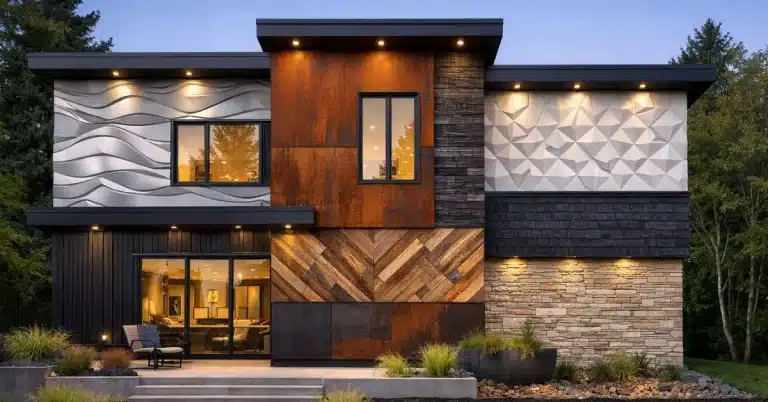
Before diving into the ideas, it’s worth understanding why scale matters.
On a larger home, a heavy stone cladding across the full facade creates grandeur. On a 5-to-6-meter frontage, that same treatment can visually anchor the house to the ground, making it feel squat and heavy. The same logic applies to colors, textures, and proportions. Dark colors that look dramatic on a wide facade can feel oppressive on a narrow one. Multiple cladding materials that work beautifully across 10 meters of elevation create visual noise on a compact plot.
Small house exterior design isn’t about doing less, it’s about doing things with intention. Every element needs to carry its weight (sometimes literally and visually).
Three design principles apply across nearly every small house exterior:
- Vertical emphasis: Any element that draws the eye upward, vertical cladding, tall narrow windows, recessed entry zones, makes a house appear taller and less compressed.
- Material restraint: Pick one dominant material (60%), one supporting material (30%), and one accent (10%). Exceeding three materials on a small facade almost always creates visual clutter.
- Strategic contrast: A single zone of contrasting material or color, at the entry, at a gable end, or framing a window, creates depth without overwhelming the overall composition.
With those principles in mind, here are the ideas.
12 Modern Exterior Wall Design Ideas for Small Houses
1. Vertical Cladding to Add Height
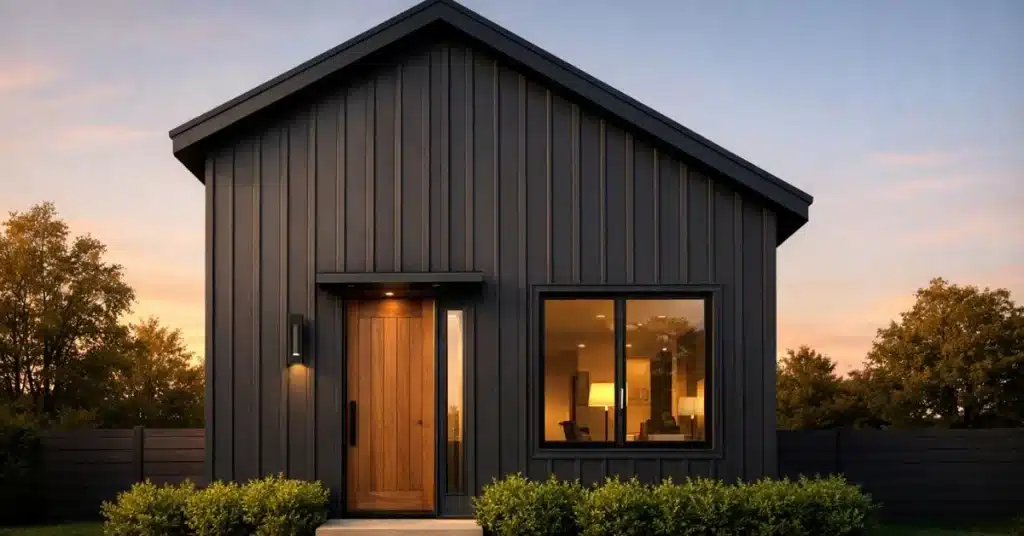
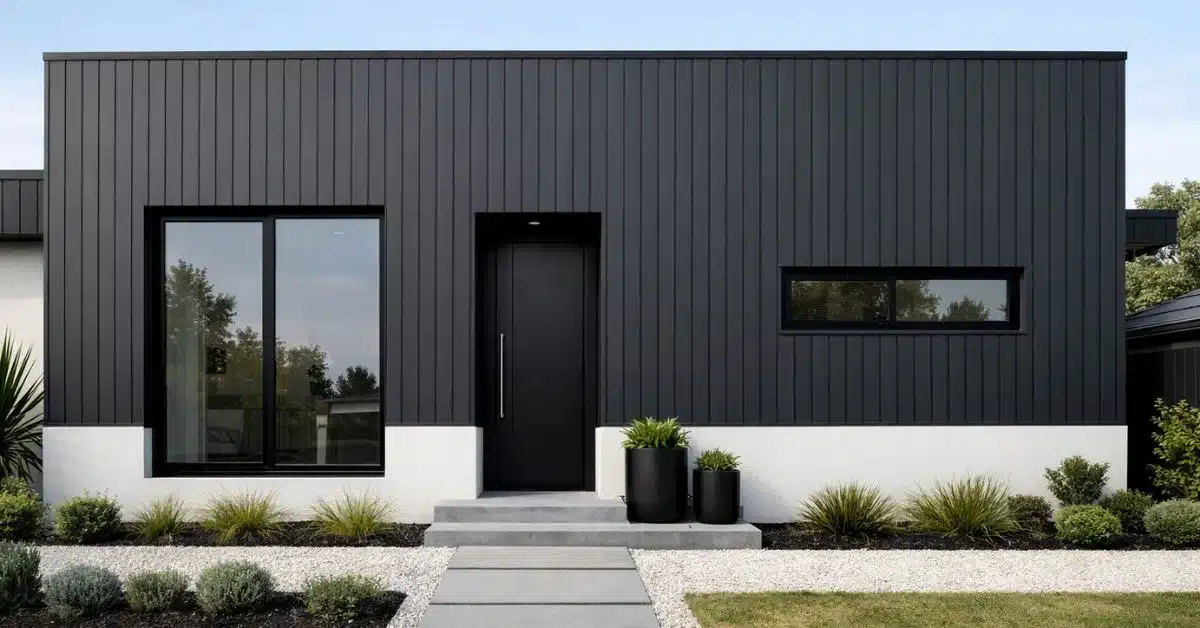
When a house feels pressed down or visually heavy, vertical cladding shifts the perception. It draws the eye upward along the facade, creating the impression of greater height without changing a single structural dimension.
Vertical timber battens, fiber cement panels installed vertically, or even vertically oriented brick patterns all achieve this effect. On a compact frontage, this is one of the highest-impact, lowest-cost adjustments available.
Board and batten siding, alternating wide boards and narrow cover strips installed vertically, is particularly effective here. It’s durable, relatively affordable at $4-9 per square foot installed with fiber cement options, and suits both contemporary and minimalist aesthetics.
Best for: Bungalows, single-story homes, narrow frontages under 7 meters.
2. Textured Render with Grooved Panels
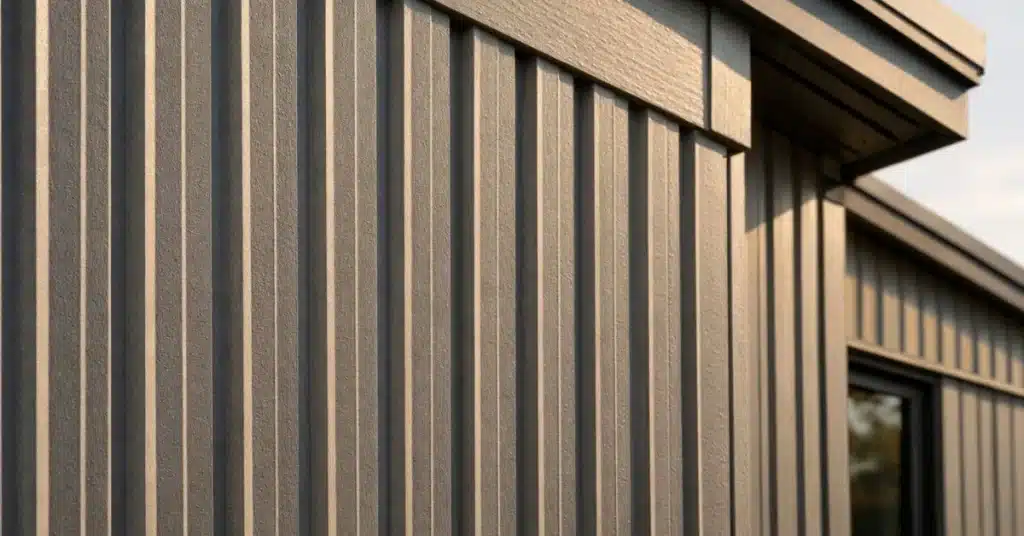
Plain smooth render works, but textured finishes do more on a small facade. Finishes with horizontal or vertical grooves, ribbed profiles, or fluted surfaces interact with natural light differently at different times of day, the shadows shift, the facade gains depth, and it stops looking flat.
In 2026, grooved and ribbed exterior panels, often in fiber cement or aluminum composite, have become one of the most popular choices for compact modern homes. They’re lightweight, durable, and require minimal maintenance compared to natural stone or timber alternatives.
The visual effect is subtle but consistent: the surface looks more expensive and considered than it actually is to install.
Material options: Fiber cement ($4-9/sq ft), aluminum composite panels ($12-25/sq ft), textured acrylic render ($6-12/sq ft).
3. Two-Tone Wall Treatment
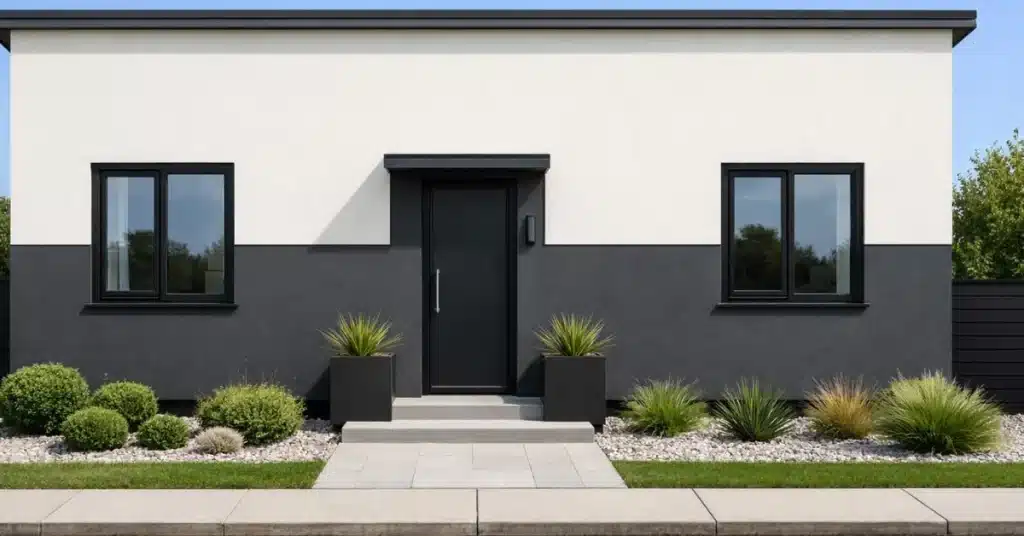
A single color across an entire small facade can read as flat. A two-tone approach, using a lighter tone for the upper facade and a darker tone or contrasting material for the lower section, gives the elevation visual layers and makes it read as more complex than it is.
The most common pairing in contemporary small house design: warm off-white or light grey for the upper walls, with a charcoal, slate blue, or deep olive for the plinth, ground-floor zone, or feature entry column.
For an even cleaner result, the color break can follow a horizontal datum line, the top of a window sill, the underside of a canopy, or the boundary between cladding materials. This gives the transition purpose rather than appearing arbitrary.
Important: Keep the darker tone at the bottom. Reversed, with dark on top, the facade looks top-heavy.
4. Stone or Brick Accent Wall at the Entry
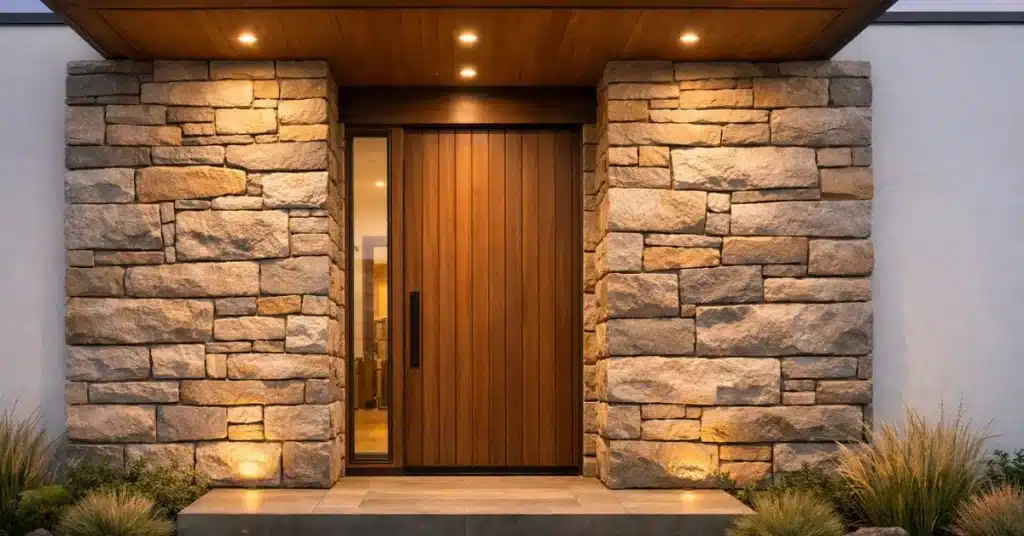
Full stone or brick cladding across an entire small facade often feels disproportionate. But a single accent wall, particularly around the entry zone, a gable end, or a chimney breast, introduces texture, warmth, and character without overwhelming the composition.
Natural stone veneer adds authentic texture and increases perceived property value. Manufactured stone veneer achieves a nearly identical visual result at lower cost and weight. Large-format porcelain slabs that mimic stone offer the cleanest, most modern interpretation of this approach, particularly when set with tight joints or dry-stacked without visible grout lines.
According to the Houzz 2023 Home Report, natural stone cladding used on focal wall areas consistently ranks as one of the top improvements for perceived home value.
Cost range: Manufactured stone veneer: $10-18/sq ft installed. Natural stone: $15-30/sq ft installed.
5. Aluminum Composite or Metal Cladding
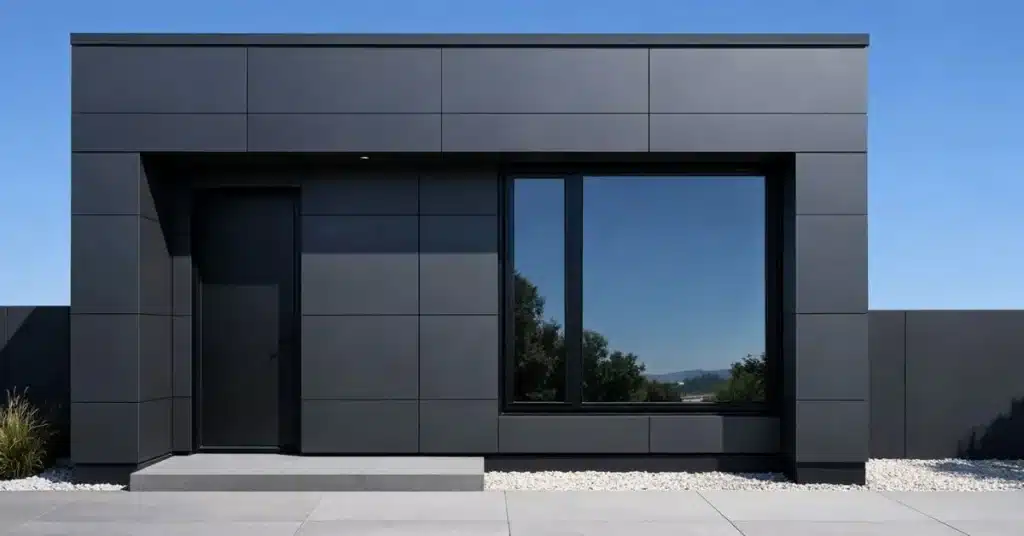
For a thoroughly contemporary look with practical advantages, aluminum composite panels (ACP) and metal cladding systems are hard to beat. They’re lightweight, weather-resistant, available in a wide range of colors and finishes, and require almost no maintenance over decades.
On small houses, ACP works particularly well when used as a feature section, the upper story, the entry canopy zone, or a projecting volume. Smooth matte finishes in charcoal, dark bronze, or warm grey give the facade a refined, low-maintenance appearance.
Ribbed or fluted aluminum panels add texture while maintaining the clean, joint-minimal aesthetic that contemporary small houses often need.
Practical advantage: Unlike timber, there’s no risk of warping, cracking, or requiring regular staining. This makes ACP a strong long-term choice in climates with significant temperature variation or high humidity.
6. Thermally Modified Timber Cladding
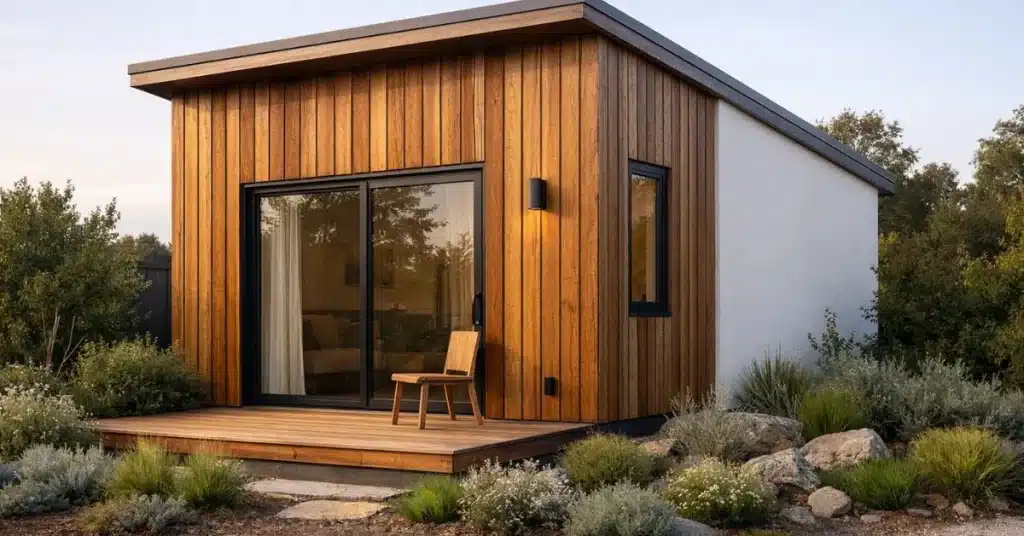
Timber remains one of the most naturally appealing cladding materials, warm, tactile, and visually honest in a way that synthetic alternatives often aren’t. The challenge with standard timber on exteriors is maintenance: it needs regular oiling or painting to resist moisture and UV degradation.
Thermally modified timber solves most of that problem. The heat treatment process reduces the timber’s moisture content and increases its dimensional stability, making it significantly more durable outdoors without relying on chemical preservatives. It naturally weathers to a silver-grey patina, or can be finished with oil to maintain its original warm tone.
Used as vertical cladding on a small house, particularly in a slatted arrangement with visible gaps, it adds warmth and depth simultaneously. The light plays through the gaps, adding shadow and texture throughout the day.
Best pairing: Thermally modified timber against smooth white or light grey render for maximum contrast.
7. Exposed Concrete Finish
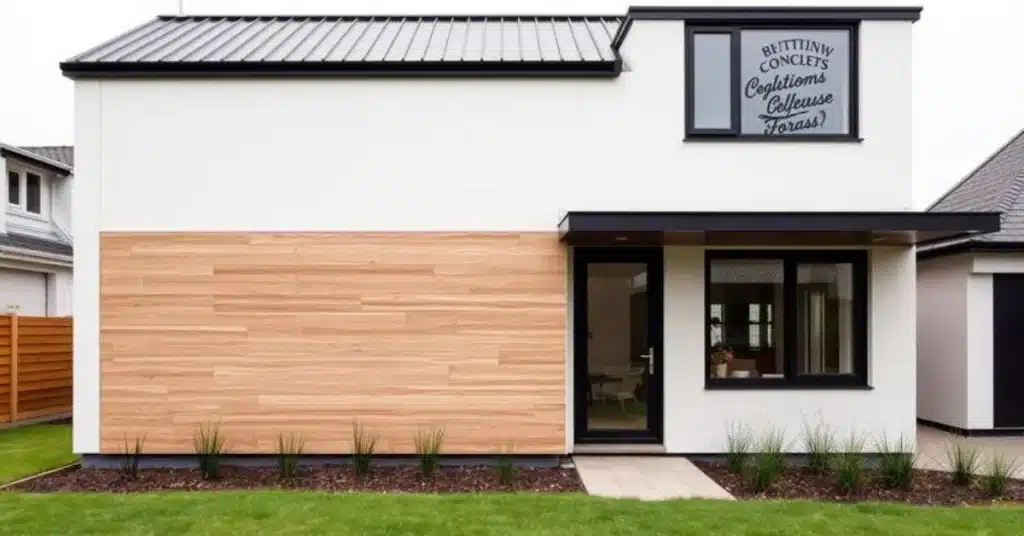
Exposed concrete is no longer purely a material for brutalist or industrial projects. When used thoughtfully on a small house, as a feature wall panel, a feature gate column, or a partial facade treatment, it communicates solidity, permanence, and understated modernity.
Board-formed concrete, where the timber formwork grain transfers to the concrete surface, is particularly effective for residential projects. It introduces warmth and texture to a material that can otherwise feel clinical.
For small houses on a tighter budget, concrete-effect render (applied over standard blockwork or frame construction) achieves a very similar visual result at a fraction of the cost and structural complexity.
Note: In tropical or high-humidity climates, exposed concrete requires a proper sealer to prevent moisture penetration and surface staining over time.
8. Green Facade and Vertical Living Walls
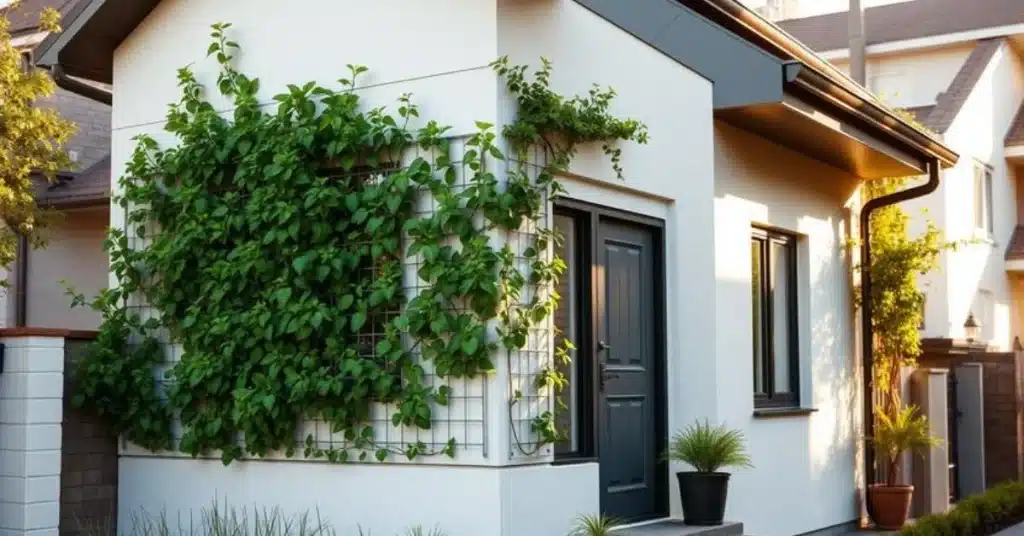
If the plot is too tight for meaningful landscaping at ground level, the facade itself can carry the greenery. Vertical living walls, climbing plants on stainless steel cable systems, or modular planter panels attached to the wall surface bring nature into the elevation without consuming floor area.
Beyond aesthetics, green facades provide a measurable practical benefit: climbing plants and living walls reduce the surface temperature of exterior walls by acting as an insulating layer, which can lower cooling costs in warm climates.
Classic climbing plants for this application include jasmine, Boston ivy, Virginia creeper, and in sheltered positions, wisteria. These require minimal infrastructure, a timber batten frame or cable trellis, and establish quickly once planted.
For a more structured result, modular living wall panels with built-in irrigation are available from brands like Sempergreen and ANS Global. These are more expensive upfront but require less ongoing management than free-climbing plants.
9. Large Windows as a Facade Design Element
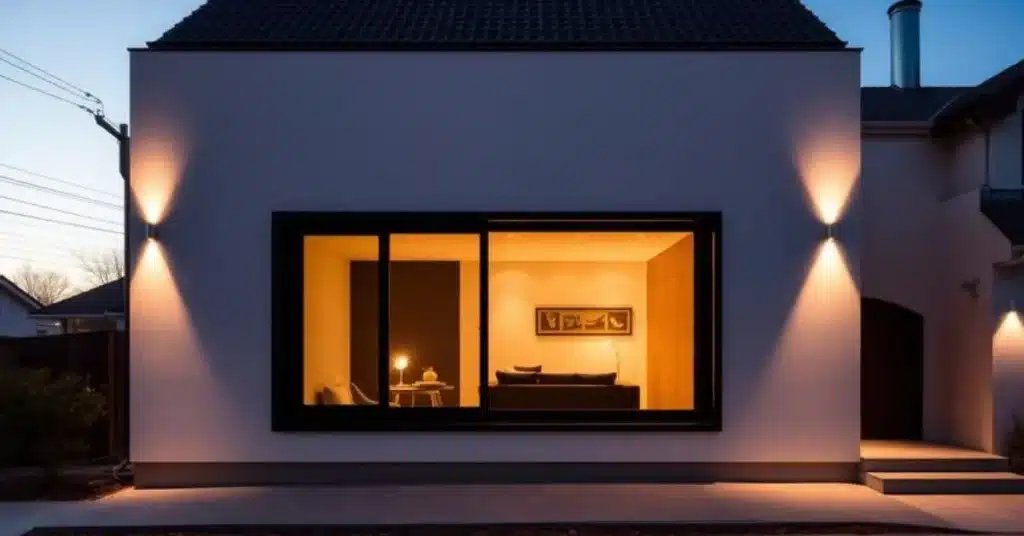
Windows shouldn’t be an afterthought on a small house exterior. They’re one of the most powerful design elements in the facade composition.
One of the most common mistakes on compact elevations is scattering multiple small windows across the frontage. This creates a fragmented, pinched appearance. Replacing several small openings with one or two larger, properly proportioned windows changes the entire character of the facade, it breathes, it feels more spacious, and it connects the interior to the exterior in a way that small windows never achieve.
Floor-to-ceiling glazing at a single wall section, a horizontal ribbon window under the roofline, or a frameless corner window are all approaches that work well on small modern houses. Powder-coated aluminum or steel window frames in black or dark grey give the openings definition and visual sharpness.
What window style works best for small house exteriors?
Large, fewer windows in a dark frame (black or charcoal aluminum) create more visual impact on small house facades than multiple small windows. A single floor-to-ceiling opening or horizontal ribbon window reads as contemporary and spacious.
10. Stucco and Lime Render in Modern Colors
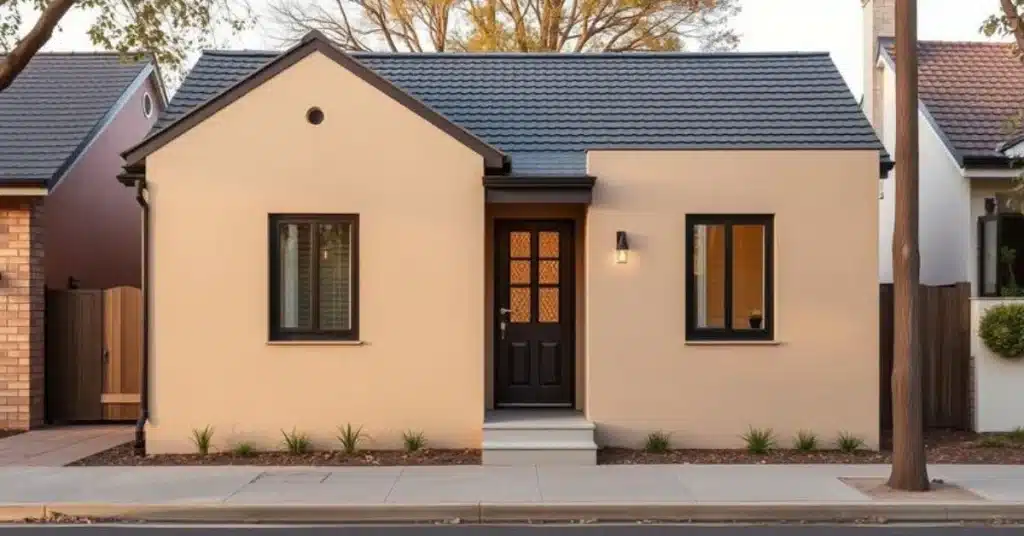
Painted stucco and lime render remain among the most cost-effective ways to achieve a clean, contemporary exterior. At $6-9 per square foot installed, they’re accessible for most renovation budgets and work with a wide range of color palettes.
The key on small houses is color selection. Light colors, warm white, off-white, pale greige, and light sage, reflect more light and visually push the walls outward, making the facade read as more open. Deeper tones can work but require careful handling: confine them to the lower zone, a feature volume, or the entry to avoid the facade feeling compressed.
In 2026, popular render colors for small modern homes include: warm greige, dusty sage, chalk white with earthy undertones, and soft charcoal for accent sections.
One practical consideration: smooth, fine-textured render finishes show imperfections more readily than coarser textures. On walls that may settle slightly or in areas with minor structural movement, a medium-grain texture is more forgiving over time.
11. Mixed Materials, Timber + Render Combination
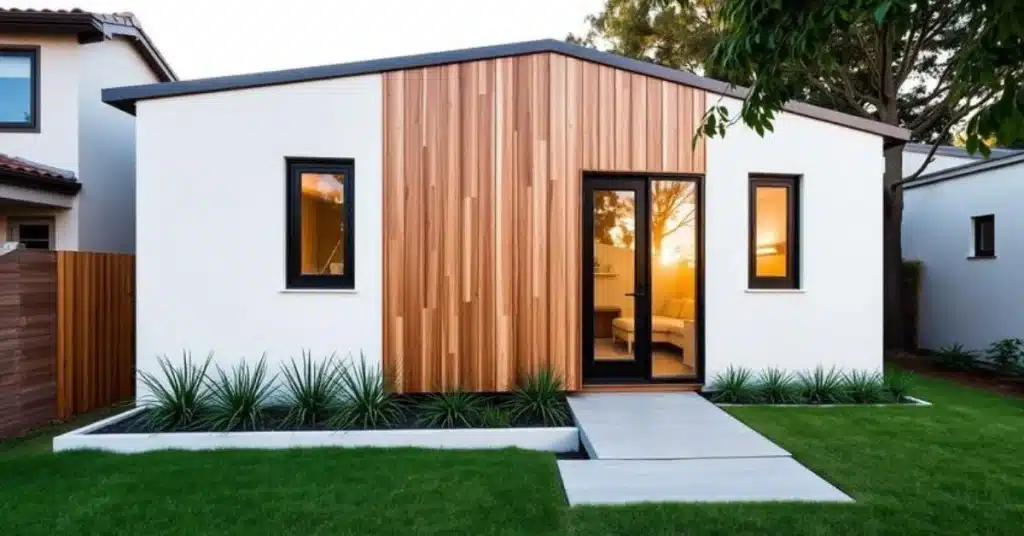
The combination of timber cladding and smooth render is arguably the most versatile and contemporary approach for small houses in 2026. It’s warm but modern, textured but controlled, and works in almost every climate with the right material choices.
The typical composition: smooth white or light grey render as the dominant surface, with vertical timber cladding used as an accent on the entry porch, a projecting volume, or the full gable end. The render gives the facade lightness and modernity; the timber adds warmth and natural character.
This is the pairing that design-forward builders return to consistently, because it’s adaptable to both new-build and renovation contexts, suits a wide range of house styles, and photographs extremely well, which matters for resale.
Rule of three applied: Render (dominant, ~60%), timber cladding (supporting, ~30%), metal window frames or fascia detail (accent, ~10%).
12. Strategic Exterior Lighting as a Design Layer
Exterior lighting is rarely discussed in the same breath as wall materials, but on a small house, it’s one of the highest-leverage design investments available. Good lighting adds dimension at night, makes the facade look intentional from the street, and, when directed at wall surfaces, highlights textures that are invisible in flat daylight.
Wall-grazing uplights pointed at textured render, timber cladding, or stone accent walls bring the surface to life after dark. Recessed ground lights along the path to the entry add layering. A single pendant or concealed LED strip at the entry canopy creates a focal point.
Brands like Davey Lighting, Delta Light, and iGuzzini produce exterior-rated fittings that balance design quality and weatherproofing. For most small house applications, a few well-placed fittings outperform a larger number of generic spotlights.
Material Comparison Table
| Material | Installed Cost | Durability | Maintenance | Best For |
|---|---|---|---|---|
| Fiber Cement Panels | $4–$9/sq ft | High | Low | Budget-friendly modern exteriors |
| Aluminum Composite Panels (ACP) | $12–$25/sq ft | Very High | Very Low | Contemporary and commercial-inspired designs |
| Thermally Modified Timber | $8–$15/sq ft | High | Low–Medium | Adding warmth and natural texture |
| Natural Stone Veneer | $15–$30/sq ft | Very High | Low | Premium accent walls and luxury facades |
| Manufactured Stone Veneer | $10–$18/sq ft | High | Low | Achieving a stone look at a lower cost |
| Textured Acrylic Render | $6–$12/sq ft | Medium–High | Low | Affordable and versatile exterior finishes |
| Painted Stucco / Lime Render | $6–$9/sq ft | Medium | Medium | Smooth, clean, modern elevations |
| Exposed Concrete (Board-Formed) | $15–$40/sq ft | Very High | Low (when sealed) | Minimalist and industrial-style homes |
Colors That Work Specifically for Small House Exteriors
Color has more visual leverage on a small facade than almost any other decision. These palettes consistently perform well:
Light and neutral: Chalk white, warm off-white (with a yellow or pink undertone rather than cool grey), pale greige, and light clay. These push the walls outward visually and keep the facade feeling open.
Two-tone approaches: Off-white upper facade + deep charcoal or slate for the lower section. Light sage render + dark bronze aluminum windows. Warm grey render + natural timber cladding.
Avoid small facades: Very dark colors across the full facade (unless the house has significant setback from the street), multiple saturated colors, and high-gloss finishes that reflect unevenly.
2026 trending combinations for small houses: Warm greige render with black aluminum windows and thermally modified timber entry surround. White render with vertical charcoal fiber cement cladding at the entry zone. Dusty sage rendered with aged bronze fascia and natural stone plinth.
Common Mistakes to Avoid
Using too many materials: Three is the ceiling. More than three cladding types, colors, or textures on a small facade creates fragmentation that makes the house look unresolved.
Scaling down large-format patterns: Geometric patterns and large-format cladding modules designed for bigger homes look awkward when squeezed onto a narrow elevation. Work with the scale of the facade, not against it.
Ignoring proportion: Windows sized too small relative to the wall, or a front door that looks underscaled, diminishes the entry and makes the whole facade feel compressed. One well-proportioned focal window or door does more than three small ones.
Horizontal cladding on a very low-pitched house: Horizontal lines emphasize width at the expense of height. On a single-story home that already sits close to the ground, this tends to make it look flatter. Vertical cladding, or a mix of vertical cladding with horizontal render, performs better.
Skipping lighting: A facade that disappears after dark misses half its potential impact. Even one or two exterior uplights aimed at a feature wall material transforms how the house reads at night.
Conclusion
Small houses don’t need elaborate facades to make an impression. The homes that read as well-designed and intentional from the street are rarely the ones with the most materials or the most complex detailing. They’re the ones where every choice of color, texture, cladding direction, window proportion was made with the scale of the building in mind. Pick one dominant material and let it breathe. Add a single accent zone that draws the eye to the entry. Keep the color palette restrained. Those three decisions alone put a small house exterior ahead of most. The rest is refinement.
FAQs
What is the best exterior wall design for a small house?
Vertical cladding combined with smooth render gives a small house a modern, proportionate look without visual clutter.
Which material works best for small house exterior walls?
Fiber cement is the best overall choice durable, low-maintenance, affordable, and available in vertical profiles that suit compact facades.
What color makes a small house exterior look bigger?
Light warm neutrals like off-white, greige, or pale clay reflect more light and make the facade feel more open.
Should I use vertical or horizontal cladding on a small house?
Vertical cladding draws the eye upward and makes the house appear taller, the stronger choice for most small or single-story homes.
What is the most low-maintenance exterior wall finish?
Aluminum composite panels require the least upkeep no repainting, no warping, and no rot regardless of climate.

As an admin, with a passion for transforming spaces and a sharp eye for design trends, I created Interior Design Style Quiz to help homeowners make confident, informed decisions about their homes from the curb all the way inside.