Transform Your Yard with an Ornamental Grasses Landscape Look
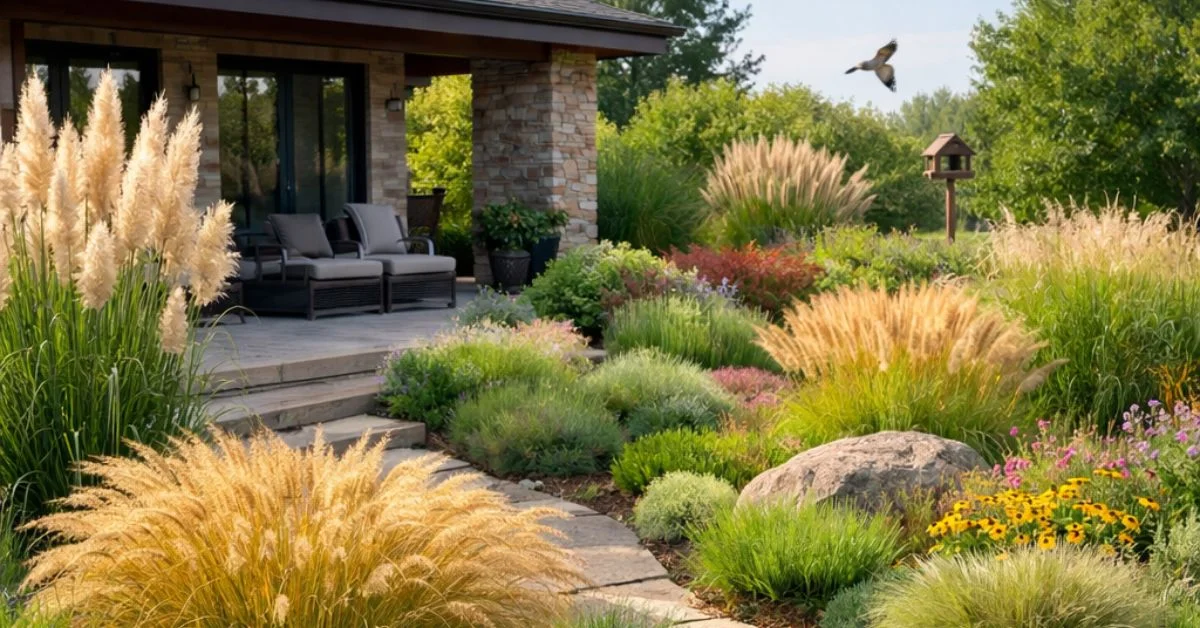
An ornamental grasses landscape transforms your yard by using structured layers of drought tolerant grasses to create four season texture, movement, and architectural form while reducing water use and maintenance.
For expert level designers and advanced homeowners, ornamental grasses are not just filler plants. They are:
★ Structural elements that define space and sightlines
★ Performance plants that stabilize soil, reduce irrigation, and support biodiversity
★ Design tools for contrast, rhythm, and seasonal drama
This guide goes deep into how to design, specify, and maintain an ornamental grasses landscape that looks curated (not chaotic) and that performs in 2026’s climate and water realities.
Why an Ornamental Grasses Landscape Outperforms Traditional Planting

The Strategic Advantages
1. Water efficiency and climate resilience
Many ornamental grasses, especially warm season and drought tolerant species, use significantly less water than traditional turf or thirsty perennials once established. Deep or fibrous root systems allow them to ride out heatwaves and irregular rainfall with minimal supplemental irrigation.
2. Four season visual performance
Unlike many perennials that peak for a few weeks, an ornamental grasses landscape offers:
★ Fresh green or blue foliage in spring
★ Full volume and plumes in summer
★ Gold, copper, and burgundy tones in fall
★ Sculptural silhouettes and seedheads in winter
3. Low input maintenance
Most ornamental grasses require:
★ One annual cutback
★ Occasional division every 3 to 5 years
★ Minimal fertilization and pest management
Compared to high input lawns or mixed borders, this is a major labor and cost reduction.
4. Ecological and functional benefits
★ Erosion control: Deep roots stabilize slopes and disturbed soils
★ Habitat: Seedheads and dense clumps support birds and beneficial insects
★ Microclimate: Taller grasses can create windbreaks and shade for understory plants
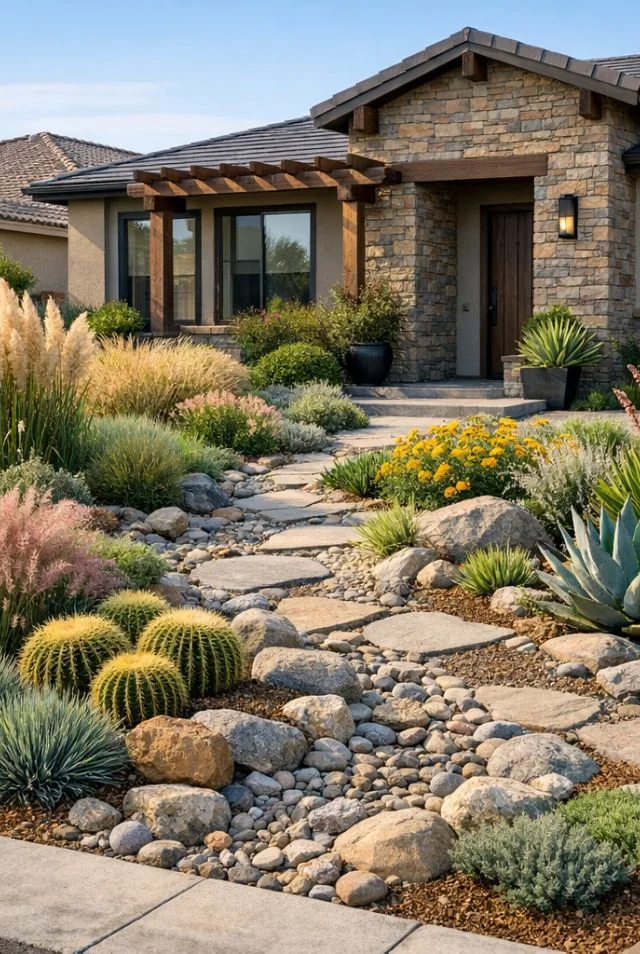
Real World Example: Front Yard Transformation in a Drought Prone Suburb
Context
A 1,200 square foot front yard in a Phoenix adjacent suburb, originally 80% turf with a narrow shrub border. Water bills were high, and the lawn struggled under heat restrictions.
Objective
Create an ornamental grasses landscape that:
★ Cuts irrigation by at least 50%
★ Maintains strong curb appeal in an HOA neighborhood
★ Provides year round structure and a modern aesthetic
Design moves
★ Removed 70% of turf, kept a small geometric “lawn panel” as a visual anchor
★ Installed a matrix of drought tolerant grasses:
• Muhlenbergia capillaris (Pink muhly) for fall plumes
• Bouteloua gracilis (Blue grama) for low textural ground layer
• Helictotrichon sempervirens (Blue oat grass) for color contrast
★ Layered boulders and a steel edged gravel path through the planting
★ Added three vertical accents of Miscanthus sinensis ‘Gracillimus’ near the entry for height and privacy
Outcome after 2 years
★ Irrigation reduced by roughly 55% after establishment
★ HOA approved and later referenced the yard as a model for “water wise curb appeal”
★ The homeowners reported “zero bare, ugly months” – the structure holds even in winter
This is a textbook example of an ornamental grasses landscape that balances aesthetics, performance, and neighborhood constraints.
Core Design Principles for an Ornamental Grasses Landscape
1. Think in Layers, Not Individual Plants
An expert level ornamental grasses landscape is built on layered structure:
★ Bones (4 to 7 feet): Tall grasses that define space
★ Fillers (2 to 4 feet): Mid layer that carries the main visual mass
★ Weavers (under 2 feet): Low grasses that knit the planting together
Typical height roles
Tall: Miscanthus, Panicum, Calamagrostis
Medium: Pennisetum, Deschampsia, Schizachyrium
Low: Festuca, Bouteloua, Carex (sedges in grass like role)
2. Use Repetition and Rhythm
Random assortments of grasses can look messy. Instead:
★ Repeat the same species in drifts or blocks
★ Use odd number groupings (3, 5, 7) for focal clumps
★ Create visual rhythm by alternating tall and medium grasses along paths or edges
3. Control Edges Ruthlessly
An ornamental grasses landscape looks intentional when edges are crisp:
★ Steel, stone, or concrete edging between gravel and planting
★ Clean transitions between grasses and hardscape
★ Clear sightlines to doors, windows, and key views
4. Design for Winter and “Off Season” Views
Ask: What does this bed look like in January? For experts, this is where the design passes or fails.
★ Choose grasses with strong winter silhouettes (e.g., Calamagrostis ‘Karl Foerster’)
★ Leave seedheads standing for structure and wildlife
★ Use evergreen or semi evergreen grasses (e.g., some Carex and Festuca) near entries
Choosing the Right Grasses for Your Ornamental Grasses Landscape
Key Selection Criteria
1. Climate and hardiness zone
★ Match species to USDA zone and local rainfall patterns
★ Warm season grasses (e.g., Panicum, Muhlenbergia) excel in hot summers
★ Cool season grasses (e.g., Calamagrostis, Festuca) shine in cooler climates
2. Soil and drainage
★ Most ornamental grasses prefer well drained soil
★ Heavy clay may require raised beds, amended soil, or species tolerant of periodic moisture
3. Growth habit and spread
★ Clump forming grasses are usually safer in residential settings
★ Rhizomatous or running grasses can become invasive if not carefully managed
4. Maintenance tolerance
★ Some species need division every 3 to 4 years
★ Others can sit for a decade with minimal intervention
Design Patterns for an Ornamental Grasses Landscape
Pattern 1: Modern Front Yard with Strong Geometry
Best for: Contemporary homes, visible street frontage, strict HOAs.
Pattern:
★ Rectilinear beds edged with steel or concrete
★ Repeated blocks of Calamagrostis ‘Karl Foerster’ for vertical lines
★ Low matrix of Festuca glauca or Bouteloua gracilis
★ One or two bold accents (e.g., Panicum ‘Northwind’) near the entry
Why it works: The grasses soften the architecture while the geometry keeps the ornamental grasses landscape from feeling wild.
Pattern 2: Naturalistic Side Yard or Slope
Best for: Awkward side yards, slopes, or areas where mowing is difficult.
Pattern:
★ Matrix planting of low grasses (e.g., Bouteloua, Deschampsia)
★ Interspersed drifts of taller species (Panicum, Schizachyrium)
★ Minimal hardscape – maybe a simple mown path or stepping stones
Why it works: The ornamental grasses landscape stabilizes soil, reduces maintenance, and turns a forgotten area into a designed “meadow.”
Pattern 3: Mixed Perennial + Ornamental Grasses Landscape
Best for: Gardeners who still want flowers but crave structure.
Pattern:
★ 40–60% grasses by volume
★ 40–60% perennials and shrubs (e.g., Echinacea, Salvia, Rudbeckia)
★ Grasses used as “weavers” between flowering clumps
Why it works: The grasses provide the backbone; perennials provide seasonal color. The ornamental grasses landscape reads as intentional, not random.
Step by Step: Building an Ornamental Grasses Landscape from Scratch
1. Site Analysis and Concept
★ Map sun exposure: Full sun vs. partial shade
★ Note drainage patterns: Where water collects or runs off
★ Identify views: From street, windows, and key outdoor spaces
★ Define the primary role of your ornamental grasses landscape: curb appeal? privacy? slope stabilization? low maintenance replacement for lawn?
2. Framework and Layout
★ Sketch bed shapes and circulation (paths, access points)
★ Place tall structural grasses first – these are your anchors
★ Add medium fillers to connect anchors
★ Finish with low weavers along edges and between clumps
3. Plant Selection and Spacing
★ Choose 3 to 7 core grass species to avoid visual chaos
★ Use consistent spacing within each species group
★ For a naturalistic ornamental grasses landscape, stagger plants in a loose grid rather than straight rows
4. Soil Prep and Installation
★ Remove existing turf or weeds thoroughly
★ Loosen soil and amend if necessary for drainage
★ Install irrigation (drip is ideal for an ornamental grasses landscape)
★ Plant grasses at the same depth as in their containers
5. Establishment Phase (Year 0 to 1)
★ Water deeply and regularly until roots establish
★ Mulch lightly (avoid burying crowns)
★ Expect modest top growth in year one – root development is the priority
6. Maturity and Refinement (Year 2 to 5)
★ Reduce irrigation significantly once plants are established
★ Evaluate which species are overperforming or underperforming
★ Edit: remove or divide clumps that are too large or visually dominant
Maintenance Blueprint for an Ornamental Grasses Landscape
Annual Maintenance Calendar (Temperate Climates)
Late winter / very early spring
★ Cut back most deciduous grasses to 4–8 inches before new growth emerges
★ Remove accumulated thatch and debris
★ Check for winter damage and crown rot
Spring
★ Spot weed aggressively – this is critical for a clean ornamental grasses landscape
★ Lightly top dress with compost if soil is poor
Summer
★ Monitor irrigation; avoid shallow, frequent watering
★ Stake only if absolutely necessary (good species selection should minimize flopping)
Fall
★ Decide which grasses to leave standing for winter interest
★ Optional: selectively cut back any that collapse early
Division and Rejuvenation
★ Many clump forming grasses benefit from division every 3 to 5 years
★ Signs it’s time: dead centers, reduced vigor, or excessive size
★ Divide in early spring (cool season) or late spring (warm season) depending on species
Advanced Tactics for Expert Level Ornamental Grasses Landscapes
1. Matrix Planting with Grasses as the “Fabric”
Instead of isolated clumps, use one or two low grasses as a continuous matrix. Example: A matrix of Bouteloua gracilis with islands of Panicum and Echinacea. The matrix unifies the composition and suppresses weeds.
2. Color and Light Manipulation
Blue and silver grasses (e.g., Helictotrichon, Festuca) cool down hot exposures and pair well with dark architecture. Golden and tawny grasses catch low angle light in fall and winter, making the ornamental grasses landscape glow at sunrise and sunset.
3. Sound and Movement as Design Elements
Taller, flexible grasses like Miscanthus and Panicum create audible rustling in wind. Use them near seating areas or windows where movement and sound can be appreciated.
4. Integrating Hardscape and Objects
Boulders, corten steel panels, and sculptural pots can punctuate an ornamental grasses landscape. The contrast between static objects and moving grasses amplifies both.
Tools and Resources for Planning an Ornamental Grasses Landscape
Design and planning
★ Landscape design software: SketchUp, Vectorworks Landmark, or simpler tools like iScape for quick visualizations
★ Plant databases: local botanical garden plant finders, regional native plant societies
Execution and management
★ Drip irrigation systems with zone control for different planting areas
★ Soil moisture sensors to fine tune irrigation in your ornamental grasses landscape
★ Long handled shears or electric hedge trimmers for efficient annual cutback
Research and inspiration
★ Public gardens with strong grass based plantings
★ Designers influenced by Piet Oudolf and contemporary meadow style planting
★ Local demonstration gardens focused on drought tolerant or native grasses
Pros and Cons of an Ornamental Grasses Landscape
Pros
★ Water savings: Especially with drought tolerant species
★ Low maintenance: One major cutback, minimal fertilization
★ Four season interest: Structure and texture even in winter
★ Ecological value: Habitat, erosion control, and soil improvement
Cons
★ Establishment period: Still requires consistent watering in year one
★ Visual preference: Some clients perceive grasses as “messy” if not carefully designed
★ Allergies: Certain species may contribute to pollen issues
★ Invasiveness risk: Poor species selection can lead to spread beyond intended areas
For experts, the goal is to maximize the pros while mitigating the cons through species choice, layout, and clear maintenance protocols.
Conclusion
A well executed ornamental grasses landscape delivers something most planting styles struggle to achieve: long term beauty with minimal inputs. When grasses become the structural backbone – supported by disciplined layout, climate appropriate species, and clean edges – you get a yard that performs visually and ecologically in every season. The combination of movement, texture, and architectural form creates a landscape that feels alive yet controlled, modern yet natural, and expressive without demanding constant upkeep.
Frequently Asked Questions
1. What makes an ornamental grasses landscape low maintenance?
Most ornamental grasses need only annual cutback, minimal watering after establishment, and no fertilization. Their clumping habit and drought tolerance make them one of the easiest landscape structures to maintain.
2. Which grasses are best for modern front yard designs?
Top choices include Calamagrostis ‘Karl Foerster’, Panicum ‘Northwind’, and Festuca glauca. Their upright forms, clean lines, and year round structure fit perfectly with contemporary architecture.
3. Can ornamental grasses survive extreme heat?
Yes. Warm season grasses like Muhlenbergia, Bouteloua, and Panicum thrive in high heat and low water, making them ideal for drought prone regions and xeriscape landscapes.
4. Do ornamental grasses provide winter interest?
Absolutely. Many grasses keep their shape, seedheads, and warm tones through winter, adding structure and movement when most plants are dormant. Cutting back is best done in late winter.
5. Can ornamental grasses replace a traditional lawn?
Yes. Low grasses like Bouteloua gracilis and select Carex species create a soft, natural ground layer that uses far less water and maintenance than turf while still offering visual cohesion.

As an admin, with a passion for transforming spaces and a sharp eye for design trends, I created Interior Design Style Quiz to help homeowners make confident, informed decisions about their homes from the curb all the way inside.