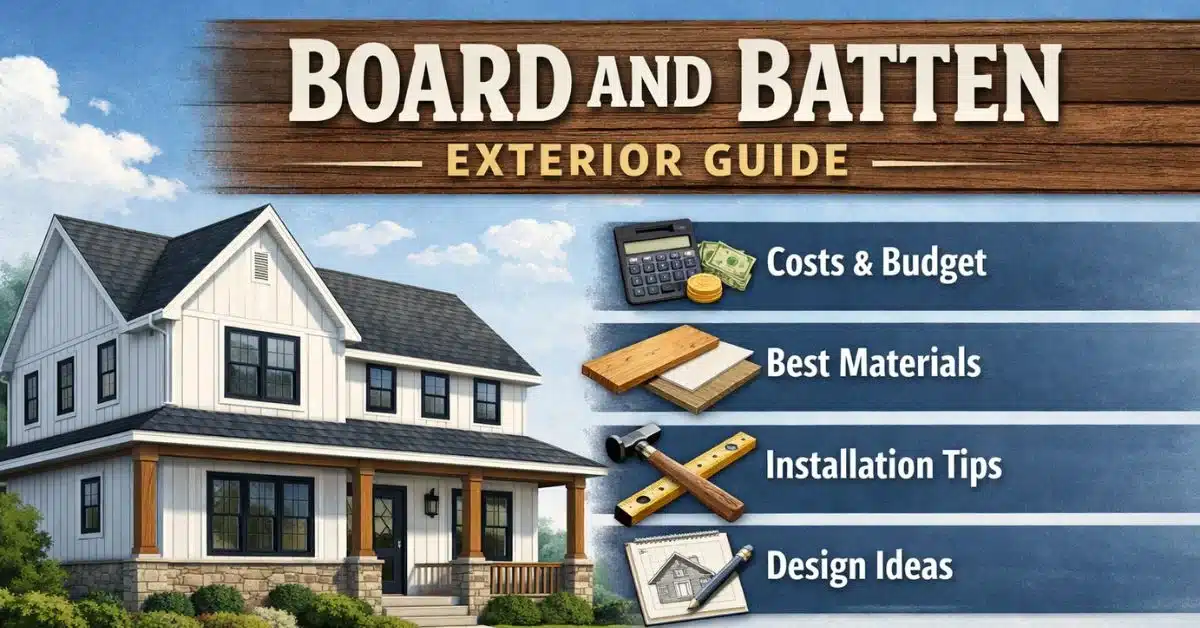
Board and Batten Exterior: Complete Guide to Costs, Materials, Installation & Design (2026)
There’s a reason board and batten keeps showing up on every home renovation shortlist. The style is clean, unmistakably vertical, and somehow works equally well on a century-old farmhouse and a brand-new modern build. It gives a home presence<u>,</u> that intentional, finished quality that separates a well-designed exterior from everything else on the block.
But choosing board and batten siding isn’t just an aesthetic decision. The material you select, the spacing of the battens, whether you DIY or hire a contractor<u>,</u> all of it shapes the final cost, the long-term maintenance load, and how well the siding actually holds up in your climate.
This guide covers everything: what board and batten actually is, which materials make sense for different budgets and climates, current cost data broken down by project size, a step-by-step look at installation, design ideas that work in the real world, and the maintenance questions most guides skip over.
What Is Board and Batten Exterior Siding?
Board and batten is a vertical siding system where wide flat boards are installed side by side across the exterior wall, and then narrower strips<u>,</u> the battens<u>,</u> are fastened over the seams where two boards meet. The battens serve two purposes: they lock out moisture by covering those vulnerable joints, and they create a raised, ribbed profile that gives the facade its distinctive texture and depth.
The “board” is typically 6 to 12 inches wide. The “batten” is typically 2 to 4 inches wide and sits proud of the face, catching the light and casting subtle shadow lines that make the exterior look intentional and three-dimensional.
The system can run strictly vertical, which is the classic configuration, or occasionally at an angle for a contemporary look. The spacing between battens<u>,</u> that is, how wide each exposed board section is<u>,</u> significantly affects the visual density of the finished wall.
A Quick History
Board and batten weren’t invented for aesthetics. Early American settlers and farmers used the technique because it was practical: wide boards were nailed to structural framing, and the battens covered the gaps left by wood that shrank and swelled with seasonal changes. The result was a weatherproof wall that also happened to look good. The style became synonymous with barns and rural structures for centuries, which is exactly why the modern farmhouse movement picked it up again<u>,</u> it carries genuine architectural DNA, not just the appearance of rusticity.
Board and Batten vs. Other Siding Styles
Before committing, it helps to understand how board and batten compares to the alternatives you’ll see on houses in your neighborhood.
The vertical lines of board and batten create a specific visual trick: they draw the eye upward, making a home appear taller and more refined. Horizontal lap siding does the opposite<u>,</u> it emphasizes width, which suits ranch-style homes but can make a two-story house look squat. If you’re trying to give a modest home more presence, vertical siding is the stronger design move.
Board and Batten Siding Materials: Which One Is Right for You?
This is the decision that shapes everything else<u>,</u> cost, lifespan, maintenance, appearance over time, and how well the siding performs in your specific climate. There are five primary material categories, and they’re not interchangeable.
1. Fiber Cement (Recommended for Most Homeowners)
Fiber cement is the current gold standard for board and batten, and for most homeowners it’s the right call. It’s made from a mixture of cement, sand, and cellulose fibers, which gives it a dimensional stability that wood simply can’t match.
Why it works well:
- Holds paint exceptionally well, often comes factory-primed or pre-painted
- Resists moisture, rot, insects, and fire (highest possible fire rating)
- Works in virtually every climate<u>,</u> from humid Gulf Coast conditions to freeze-thaw cycles in the northern Midwest
- Realistic wood grain texture that photographs well and reads as premium
- Lifespan of 50+ years with proper maintenance
The tradeoffs:
- Heavier than wood or vinyl, which means installation is more labor-intensive
- Can crack if mishandled during installation
- Higher upfront cost than vinyl
Brands worth knowing: James Hardie (HardiePlank and HardiePanel), Allura, Nichiha, LP SmartSide (technically engineered wood, but often compared directly to fiber cement in performance)
Cost: $6<u>-</u>$15 per square foot installed
The 2025 Cost vs. Value Report from Remodeling Magazine found that fiber cement siding replacements average a 114% return on investment<u>,</u> meaning it tends to add more value than it costs, which is unusual for any home improvement project.
2. Engineered Wood
Engineered wood board and batten of Small Exterior Home Design Ideas sits between real wood and fiber cement in both price and performance. Products like LP SmartSide use strand-based composite technology with resin binders and a zinc borate treatment that resists fungal decay and insects.
Why it works well:
- Lighter than fiber cement, easier to cut and install
- Realistic wood appearance<u>,</u> more convincing grain than vinyl
- More affordable than fiber cement or real wood
- Accepts paint and stain readily
The tradeoffs:
- Less fire-resistant than fiber cement
- Susceptible to moisture damage if end cuts aren’t properly sealed during installation
- Shorter track record than fiber cement (though LP SmartSide’s field history is now 30+ years)
Cost: $2<u>-</u>$5.50 per square foot for materials; roughly $6<u>-</u>$8/sq ft installed
3. Vinyl
Vinyl board and batten is manufactured as a single interlocking panel where the boards and battens are already integrated<u>,</u> you’re not installing two separate components. That makes it faster to install and eliminates the seam-related moisture risk of traditional two-piece systems.
Why it works well:
- Lowest upfront cost of any board and batten material
- No painting required; color is integral to the material
- Lightweight and easy to install
- Insect-resistant
The tradeoffs:
- Can dent or crack under impact (hail, flying debris)
- Expands and contracts significantly with temperature swings, which can cause buckling in extreme climates
- Environmental concerns related to PVC production
- Doesn’t hold the same resale value as fiber cement
Cost: $5<u>-</u>$9 per square foot installed
Vinyl is the right choice when budget is the primary constraint. It does the job, it looks reasonably good from the street, and the maintenance demand is minimal. It’s not the material you’d choose if you’re looking at this as a long-term investment or if you’re in a climate with extreme temperature swings.
4. Real Wood
Traditional wood<u>,</u> cedar, pine, redwood, cypress<u>,</u> is where the style originated, and it still has its advocates. Cedar is the top choice within wood options because it contains natural oils that resist moisture and insects without the chemical treatments that engineered wood requires.
Why it works well:
- Unmatched natural appearance; accepts stain and paint beautifully
- Repairable<u>,</u> damaged sections can be replaced without affecting the surrounding area
- Genuinely warm aesthetic that fiber cement approximates but never quite replicates
The tradeoffs:
- Requires repainting or restaining every 3<u>-</u>7 years
- Susceptible to rot, insect infestation, and warping if maintenance is deferred
- Most expensive option when total cost of ownership (including maintenance) is factored in
- Not suitable for wet, humid climates without premium maintenance protocols
Cost: Cedar runs $2.80<u>-</u>$3 per square foot for materials alone; fully installed with labor, expect $8<u>-</u>$16/sq ft depending on species and region
Wood is the right choice when authenticity matters more than convenience, and when you have both the budget and the willingness to maintain it properly.
5. Steel and Metal
Steel board and batten comes in seamless interlocking panels and is primarily found on commercial buildings and high-end residential projects in markets where durability and longevity are the top priorities.
Why it works well:
- Extremely durable<u>,</u> decades of lifespan with minimal maintenance
- Fire-resistant and impact-resistant
- Works in any climate, including coastal environments (with proper coatings)
The tradeoffs:
- Highest cost of any option
- Susceptible to rust if the coating is scratched and moisture gets in
- Can dent under significant impact
- Heavier than vinyl or engineered wood
Cost: $7<u>-</u>$16 per square foot installed
How Much Does Board and Batten Exterior Cost?
Cost is the question most homeowners start with, and the answer is: it depends on the material, the size of your home, the complexity of the architecture, and where you live. Here’s the clearest picture current pricing data can give you.
Average Cost by Material (Installed, Per Square Foot)
The national average for a full board and batten installation across all materials is approximately $7.72 per square foot, with total projects typically landing between $8,500 and $27,300 depending on home size and material selection.
What Drives the Cost Up?
Material choice is the single biggest variable<u>,</u> it can shift your per-square-foot cost by $10 or more.
Labor typically represents 33% of total project cost and runs $1.75<u>-</u>$7 per square foot depending on your location and the complexity of the job. Metropolitan areas consistently run 20<u>-</u>40% higher than rural markets.
Architectural complexity matters more than most homeowners expect. A simple rectangular box-shaped home is straightforward to side. Add dormers, bay windows, multiple gables, or a second story, and labor costs climb quickly<u>,</u> each irregular feature requires custom cutting, additional waste, and more time.
Old siding removal, if needed, adds $1,000<u>-</u>$3,000 to most projects.
Permits typically run $500<u>-</u>$2,000 depending on your municipality and the scope of the work. Skipping permits is not worth the risk<u>,</u> unpermitted exterior work can create serious problems at resale.
Paint or finishing adds cost if your chosen material arrives unfinished. Factory-finished products cost more upfront but eliminate the post-installation painting bill.
How Board and Batten Is Installed: The Professional Process
Understanding the installation process helps you evaluate contractor bids, catch potential problems early, and set realistic expectations for the timeline.
Step 1: Surface Preparation
The existing exterior wall is inspected and any damaged sheathing is repaired. This is not a step to rush<u>,</u> siding over compromised sheathing is one of the most common causes of premature siding failure.
Step 2: House Wrap / Moisture Barrier
A water-resistive barrier (WRB)<u>,</u> typically a product like Tyvek HomeWrap or Typar<u>,</u> is applied over the entire exterior wall. This is the most critical layer in the system. The WRB allows vapor to escape from the wall cavity while blocking liquid water from entering. On fiber cement and wood installations, this step is non-negotiable. Some vinyl panel systems incorporate moisture management into the panel design, but a proper WRB is still best practice.
Step 3: Installing the Wide Boards
The broad boards are fastened vertically to the wall studs, typically using galvanized nails or screws. Boards are spaced slightly apart to allow for expansion<u>,</u> this is especially important with wood and engineered wood. The exact spacing depends on the material’s expansion coefficient and the manufacturer’s installation guidelines.
Step 4: Installing the Battens
The narrow battens are centered over the gaps between boards and fastened through both the batten and into the studs. The battens overlap both board edges by at least ¾ inch on each side, creating the waterproof seal at each seam. Battens are typically face-nailed with two nails at each stud.
Step 5: Trim, Flashing, and Finishing
Window surrounds, corner trim, and door casings are installed and carefully integrated with flashing tape to direct any water that penetrates the outer layer away from the structure. All end cuts on fiber cement and wood are sealed with primer or end-cut sealant immediately after cutting.
Step 6: Caulking and Sealing
All penetrations, trim joints, and transitions are caulked with a high-quality paintable caulk. The gap between siding and any horizontal trim (like window sills) should be left slightly open at the bottom to allow drainage<u>,</u> completely sealing this joint is a common mistake that traps moisture.
Step 7: Paint or Final Finish
Unfinished products receive their paint or stain application. Factory-finished fiber cement typically requires a final coat of matching paint over any field cuts.
Timeline
A professional crew typically completes a standard single-story home in 3<u>-</u>7 days. Multi-story homes or those with complex architectural features can take 1<u>-</u>2 weeks. Fiber cement takes longer than vinyl or engineered wood because it’s heavier and requires more careful handling.
DIY vs. Professional Installation: An Honest Assessment
Board and batten is technically within reach for an experienced DIYer<u>,</u> the installation logic is straightforward and the tools required aren’t exotic. But there are real reasons most homeowners hire professionals.
Where DIY makes sense:
- You have solid carpentry experience and can work safely at heights
- You’re doing a small accent area (a gable, an entry feature) rather than full-house siding
- You’re working with vinyl panels, which are lighter and more forgiving than fiber cement
Where professionals are worth the cost:
- Full-house re-siding projects almost always benefit from professional installation<u>,</u> the moisture management details (flashing, WRB lapping, end cuts) are where amateurs most commonly make costly mistakes
- Fiber cement requires specific tools and handling<u>,</u> it’s heavy, abrasive, and dusty when cut
- Most manufacturers void their warranty on professional-grade products if they’re not installed by a certified contractor
- Permits in many jurisdictions require licensed contractor work
If you’re comparing bids, a reasonable labor cost is $1.75<u>-</u>$7 per square foot. Be wary of bids significantly below this range<u>,</u> cutting corners on moisture management creates problems that don’t show up for two or three years, by which point the warranty period may have passed.
Board and Batten Design Ideas: What Works in the Real World
The style is flexible, and how you deploy it shapes the character of the finished home significantly.
Full-Exterior Coverage
Using board and batten across the entire facade creates a bold, unified look that’s particularly effective on farmhouse-style homes. White or off-white board and batten with black trim<u>,</u> windows, doors, fascia<u>,</u> is the combination that keeps appearing on design feeds for good reason. It’s high-contrast without being aggressive, and it photographs exceptionally well.
For a more contemporary take, charcoal or deep green board and batten with warm wood accents at the entry creates a modern farmhouse look that feels current without being trendy.
Accent Applications
Board and batten doesn’t have to cover the whole house. Using it selectively on gable ends, upper stories, or as a wainscot band on the lower third of the facade creates visual layering without the full commitment. This is how contemporary farmhouse designers are using it now<u>,</u> sparing and thoughtful rather than applied to every surface.
Mixed-material facades pair board and batten beautifully with brick, stone veneer, or horizontal lap siding. A common approach: lap siding on the main body of the house with board and batten on gables and accent walls, tied together with consistent trim color.
Color Strategy
Neutral palettes perform best over time. Beige, warm white, greige, and soft charcoal all age well and adapt as trim and roof colors are updated. Darker board and batten colors<u>,</u> deep navy, forest green, near-black<u>,</u> are increasingly popular and work particularly well on homes where the board-and-batten is paired with natural stone or wood accents.
The trim color is doing a lot of work. White trim reads as classic and clean. Black trim reads as modern and intentional. Matching the trim to the siding creates a monolithic, contemporary look that some homeowners find striking.
Batten Spacing and Width
Narrower batten spacing (boards at 8 inches wide) creates a denser, more heavily textured look<u>,</u> it emphasizes the vertical rhythm. Wider spacing (boards at 12<u>-</u>14 inches) is more restrained and contemporary. The width of the battens themselves<u>,</u> typically 2 to 4 inches<u>,</u> also affects the shadow line depth and overall visual weight of the facade.
Board and Batten Maintenance: What It Actually Takes
Maintenance demands vary substantially by material. Here’s what you’re signing up for with each option.
Fiber cement: Annual inspection for paint chips, caulk checks at trim joints, gentle cleaning with low-pressure water. Repaint every 10<u>-</u>15 years depending on paint quality and sun exposure. No significant structural maintenance if installation was done correctly.
Engineered wood: Similar to fiber cement. Inspect end cuts and painted edges annually<u>,</u> any exposed wood needs immediate attention to prevent moisture intrusion. Don’t use high-pressure washing.
Vinyl: Hose down annually to remove dirt and oxidation. No painting. No sealing. Inspect for cracking or impact damage after severe weather events.
Real wood: Inspect and repaint or restain every 3<u>-</u>7 years without exception. Annual checks for signs of rot at ground-level boards, around windows, and at any end cuts. This is the material that punishes deferred maintenance most harshly.
Steel: Annual inspection for scratches or coating damage. Touch up any exposed metal immediately to prevent rust. Otherwise very low maintenance.
How Board and Batten Affects Home Value and Resale
Exterior siding is one of the few home improvement projects with data to back up the ROI claim. According to the 2025 Remodeling Cost vs. Value Report, fiber cement siding replacements recoup an average of 114% of the project cost at resale<u>,</u> one of the highest returns of any exterior project tracked.
Even at lower ROI ranges, board and batten improvements tend to pay for themselves in two ways: the direct resale premium from improved curb appeal, and the avoided cost of deferred maintenance on failing siding.
Buyers notice the exterior first. A home with clean, well-maintained board and batten siding signals that the owners take care of things<u>,</u> which is the subtext buyers are actually reading when they evaluate curb appeal.
Conclusion
Board and batten exterior siding is one of the smartest upgrades a homeowner can make. It delivers real curb appeal, long-term durability, and strong resale value all at once. Whether you go with fiber cement for maximum performance, engineered wood for mid-range value, or vinyl for budget flexibility, the style holds up across materials, climates, and architectural types. Pick the right material for your region, hire a contractor who understands moisture management, and this is an exterior finish that will still look sharp decades from now.
FAQs
What is board and batten exterior siding?
It’s a vertical siding system of wide boards with narrow strips (battens) covering the seams, creating a textured, dimensional look.
How much does board and batten exterior siding cost?
Installed costs range from $5 to $13 per square foot, with most full-home projects totaling between $8,500 and $27,300.
What is the best material for board and batten exterior?
Fiber cement is the best overall choice for durability, low maintenance, and return on investment.
How long does board and batten siding last?
Fiber cement and steel last 50+ years; vinyl lasts 20–40 years; wood lasts 40+ years with consistent maintenance.
Does board and batten exterior add home value?
Yes, fiber cement board and batten siding averages a 114% ROI at resale according to the 2025 Cost vs. Value Report.

As an admin, with a passion for transforming spaces and a sharp eye for design trends, I created Interior Design Style Quiz to help homeowners make confident, informed decisions about their homes from the curb all the way inside.