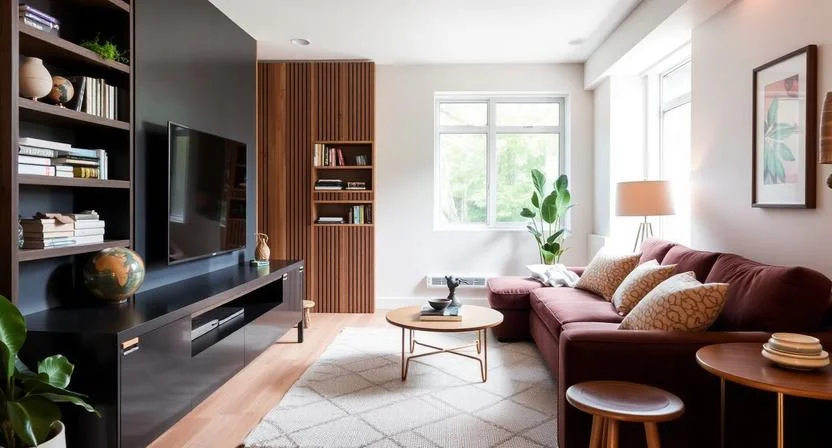
Narrow Living Room Ideas with TV: 12 Smart Fixes
A Narrow Living Room Ideas with TV typically under 12 feet wide requires specific strategies to fit a TV without the space feeling like a hallway. The most effective fixes are: wall-mounting the TV to free floor space, sizing the screen using the “viewing distance ÷ 2 = screen inches” rule, keeping main walkways at least 30 inches wide, choosing low-profile furniture, and using vertical storage. Light paint colors and mirrors also help visually widen the ro
Narrow Living Room Ideas with TV: 12 Smart Fixes
A narrow living room with a TV is one of the trickiest layouts in home design. The room’s limited width generally less than 12 feet restricts the types of furniture and arrangements that work best. Get it wrong and the room feels like a hallway. Get it right and it feels intentional, cozy, and surprisingly spacious. Every idea below solves a real problem you’re likely facing.
How Do You Arrange a Narrow Living Room with a TV?
Start with one rule: the TV goes on the short wall, and the sofa faces it along the long wall. One of the most common mistakes in long and narrow rooms is lining all furniture along one wall that creates a hallway feel rather than a living space. Place the sofa against the longest wall, the TV on the opposite short wall, and leave at least 30 inches between any two pieces of furniture for traffic flow.
1. Wall-Mount the TV.
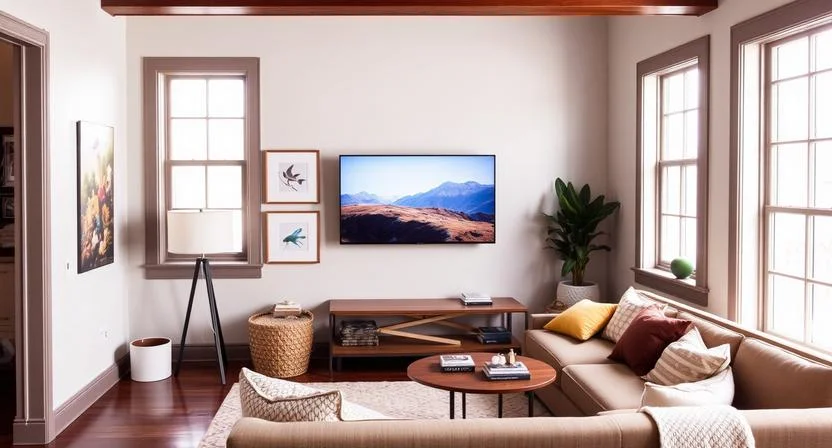
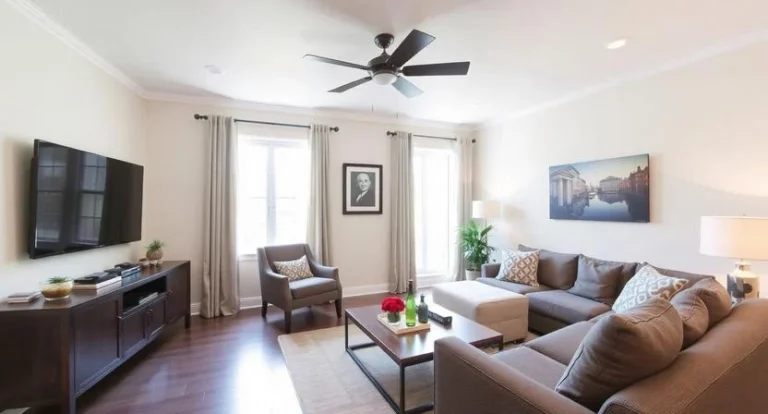
One of the most obvious and impactful ideas is to mount your TV on the wall opposite your couch. It’s one of the best places to put a TV in a small living room. Wall mounting eliminates the need for a console, freeing up floor space and visual weight simultaneously.
Mount the TV so the center of the screen sits at 42–48 inches from the floor roughly eye level when seated. Use a tilting or swivel mount if you want viewing flexibility without repositioning furniture.
Cost: Wall mounts range from $30 for basic fixed mounts to $150+ for full-motion articulating arms.
2. Choose the Right TV Size
The formula: Viewing distance (inches) ÷ 2 = ideal screen size (inches).
If you generally sit 10 feet (120 inches) back from the TV, your TV should be around 60 inches. If you sit 5 feet back, aim for about 30 inches. For most narrow living rooms where seating is 6–9 feet from the wall, a 43–55 inch screen hits the sweet spot.
Going larger than this in a narrow room doesn’t improve the experience it dominates the wall and makes the space feel compressed.
3. Maintain Proper Walkway Clearance
Never sacrifice circulation for seating.
A general guideline suggests leaving at least 30–36 inches of space for main walkways between large furniture pieces. In smaller living rooms, this can be reduced to 24 inches if necessary.
If you can walk from your front door to the kitchen without turning sideways, the layout works. If you can’t, the sofa is too large or too far from the TV wall. Consider a loveseat instead of a full sofa it recovers 18–24 inches of walkway instantly.
4. Float the Furniture (Don’t Push It Against the Walls)
Counterintuitive but effective: furniture away from the walls reads as more spacious, not less.
Don’t be afraid to float furniture off the walls in a small space, especially in the name of conversation and practicality. Pulling the sofa even 4–6 inches from the wall creates a visual lane around the room’s perimeter, which tricks the eye into reading the space as larger.
Pair a floating sofa with a narrow console table behind it for a place to set remotes, a lamp, or books without adding floor clutter.
5. Ditch the Coffee Table (Or Downsize It)
The coffee table is often the biggest space-thief in a narrow room.
The space between the couch and the TV is already narrow, and adding a coffee table can essentially block the walking path. A side table tucked into the corner and a leather pouf work well as alternatives they can be moved around easily.
If you want a surface, try nesting tables (stackable, push one away when not needed) or a slim rectangular tray on legs rather than a standard 48-inch square coffee table. Every inch of walkway you recover here makes the room feel significantly more open.
6. Use a Slim or Floating TV Console
When wall mounting isn’t an option, go as slim as possible.
Opt for floating shelves or a narrow console table that doesn’t take up too much space. If you need storage, pick a piece that keeps the floor visible and offers drawers or compartments to minimize clutter.
Target a console that is no more than 16–18 inches deep. A floating console mounted to the wall (no legs touching the floor) is the visual equivalent of wall-mounting the TV itself the visible floor area increases, and the room breathes.
7. Go Vertical with Storage
When floor space is limited, the wall above the TV is prime real estate.
Shelving around or above the TV is a way to maximize vertical space for storing books, decor, or speakers. By keeping the floor clear and utilizing walls for storage, the room remains orderly and spacious.
For [living room storage ideas], floating shelves flanking the TV create a built-in look without the cost of actual built-ins. Keep the shelves loosely styled overfilling them crowds the TV and makes the wall feel heavy.
8. Try a Corner TV Placement
An underused solution for very tight rooms.
Mounting the TV in a corner or using a corner TV stand puts it at a 45-degree angle and frees both side walls entirely. A corner TV stand is specifically designed to maximize space and create a tidy, intentional layout where a regular stand would look awkward.
The trade-off: viewing angles are better for people seated in the center of the room, but people on the far ends of a sofa may need to turn. A swivel wall mount solves this.
9. Use Light Paint Colors and Mirrors
Color and reflection are free space-makers.
Light colors make a room feel bigger and brighter, while dark hues tend to make it feel smaller and more enclosed. Smooth, shiny surfaces can reflect light and help open up the space.
For a narrow living room, paint the two long walls in a warm neutral (off-white, light greige, pale sage). If you want to add visual width without moving a single piece of furniture, hang a large mirror on one of the long side walls it doubles the perceived depth of the room.
This pairs naturally with content on [living room color ideas] to explore full palette options.
10. Add Bias Lighting Behind the TV
A cheap upgrade that makes the room feel intentional.
LED strip lights mounted to the back of your TV (bias lighting) reduce eye strain by softening the contrast between the bright screen and the dark wall. In a narrow room where the TV is naturally close to the seating, bias lighting meaningfully reduces fatigue during extended viewing sessions.
Budget: Under $30 for a basic USB-powered LED strip. Color temperature of 6500K matches most TV backlighting.
11. Pick the Right Seating Scale
Oversized seating is the #1 mistake in narrow living rooms.
For narrow rooms, a standard sofa facing the TV wall with one slim chair or an ottoman can keep the layout open. A loveseat (typically 52–65 inches wide) gives you two comfortable seats without eating the walkway. Pair it with one armless accent chair on the side not at the end, which would block traffic.
Avoid: sectionals, recliners, three-seat sofas wider than 80 inches. These pieces work in wide rooms; in narrow ones, they create a one-row theater and destroy conversational flow.
12. Use a Samsung Frame TV (or Art-Mode Display)
Hide the TV when it’s off.
Modern TVs like The Frame from Samsung blend in as pieces of art when not in use, thanks to their art modes and customizable bezels. In a narrow room where the TV wall is the dominant feature, having it display curated artwork when off transforms the room’s feel entirely.
This is particularly effective in narrow rooms where the TV cannot be tucked into an alcove or flanked by cabinetry the art mode does the visual work of “blending in” without requiring any construction.
Narrow Living Room TV Layout: Comparison Table
| Placement Type | Best For | Trade-Off | Approx. Cost |
|---|---|---|---|
| Wall mount (fixed) | Any narrow room | Requires stud/anchor work | $30–$80 |
| Wall mount (swivel) | Multiple seating angles | Slightly more wall damage | $80–$150 |
| Corner mount | Very tight rooms | Angled viewing only | $40–$200 |
| Slim floor console | Renters, no drilling | Takes up floor space | $80–$400 |
| Built-in alcove | Permanent homeowners | High cost, not movable | $500–$3,000+ |
| Above fireplace | Combined focal point | Neck strain risk if too high | Varies |
| Frame TV (art mode) | Design-focused rooms | Higher TV cost | $800–$2,500+ |
What Colors Work Best in a Narrow Living Room?
Light, warm neutrals off-white, warm greige, pale sage green are the most effective. They reflect natural and artificial light, reducing shadow depth and making the long walls feel closer to each other. Avoid painting all four walls the same dark color; if you want an accent wall, make it the short wall behind the TV.
What Furniture Should You Avoid in a Narrow Living Room?
Skip anything with bulk at floor level. The worst offenders: sectional sofas (they require the sofa to turn a corner, consuming 8–10 feet of width), entertainment centers wider than 60 inches, large square coffee tables, and recliners. Each of these narrows the walkable lane and forces every other piece of furniture to compete for the leftover floor space.
Can You Put a Sofa Against the Wall in a Narrow Living Room?
Yes, but pulling it out 4–6 inches is better. When a living room feels closed off, it’s usually because the sofa blocks circulation, the coffee table crowds knees, or the TV forces furniture too far apart. A sofa flush against the wall looks logical but creates dead space at the back and makes the room feel more cramped than floating the furniture by even a small margin.
Is a 55-Inch TV Too Big for a Narrow Living Room?
It depends entirely on viewing distance. If your seating is 8–10 feet from the wall, a 55-inch screen works well without overwhelming the space. If your sofa is closer than 7 feet to the TV wall, a 43–50 inch screen is a better fit the viewing angle gets too wide with a larger screen at short distances, causing neck movement rather than a comfortable head-still experience.
Conclusion
Narrow Living Room Ideas with TV don’t require major renovation they require the right sequence of decisions. Start with the TV placement: wall-mount it, size it correctly for the viewing distance, and center it at eye level. Then scale the furniture down: choose a loveseat over a full sofa, eliminate or replace the coffee table, and pick a slim or floating console. Finally, use the vertical wall space and light colors to make the room feel wider than it is. For small living room decorating ideas or living room layout ideas, these principles stack directly a narrow room is simply a small room with one dimension more constrained than the other.
FAQs
Q: What is the best TV size for a narrow living room?
For rooms where seating is 6–8 feet from the wall, a 43–50 inch TV is ideal; for 8–10 feet of distance, 55 inches works well.
Q: Should you mount a TV in a narrow living room?
Yes, wall mounting frees floor space, keeps the room visually open, and allows furniture to be scaled and positioned independently of a console.
Q: How do you make a narrow living room look wider?
Use light paint colors on the long walls, hang a large mirror on one side wall, choose low-profile furniture, and keep the floor as clear as possible.
Q: What is the minimum walkway space in a living room?
The recommended minimum is 30–36 inches for main walkways; 24 inches is the bare minimum in tight spaces where 30 inches isn’t achievable.
Q: Can a sectional sofa work in a narrow living room?
Rarely, sectionals require significant width to turn a corner and typically block walkways in rooms under 14 feet wide; a loveseat plus one accent chair is a better choice.

As an admin, with a passion for transforming spaces and a sharp eye for design trends, I created Interior Design Style Quiz to help homeowners make confident, informed decisions about their homes from the curb all the way inside.